December 23, 2025
Daily Current Affairs for UPSC : 23 Dec 2025/: What is General Government?
Why in News ? NK Singh (former Chairman of the 15th Finance Commission) is in the news for his inaugural address at the 108th Annual Conference of the Indian Economic Association (IEA), held at Osmania University, Hyderabad, in December 2025.
Focus on “General Government”:
Singh emphasized that global investors do not just look at the Central Government’s fiscal health; they look at the General Government, which includes both the Centre and the States.
- Unified Fiscal Health: He argued that India’s appeal as an investment destination depends on the combined fiscal discipline of all levels of government.
- Transparency: He called for a clear, credible framework for reporting the “general government” debt to reduce information asymmetry for international financiers.
Reforming the FRBM Act:
A major highlight was his critique and suggestions regarding the Fiscal Responsibility and Budget Management (FRBM) Act.
- The 2017 Gap: He noted that while the Centre adopted the second FRBM in 2017, many states have not yet amended their own policies to match.
- Incentivizing States: He proposed that states should be “cajoled and incentivized” into accepting the 2017 amendments to ensure a uniform fiscal glide path.
- Debt as an Anchor: He supported Finance Minister Nirmala Sitharaman’s stance that debt should be the principal fiscal anchor rather than just the fiscal deficit.
Democracy and Development:
Singh addressed the long-standing debate on whether democracy hinders economic speed, specifically comparing India and China.
- Symmetry: He asserted that democracy and development are “symmetrical” and not inimical, suggesting that India’s recent growth proves freedom can harmonize with economic progress.
- China Comparison: He noted that while India and China were similar in size until 1980, China’s per capita income is now 5.5 times that of India’s. He attributed this not to authoritarianism, but to China’s early adoption of trade as an “engine of growth” rather than something to be “rationed.”
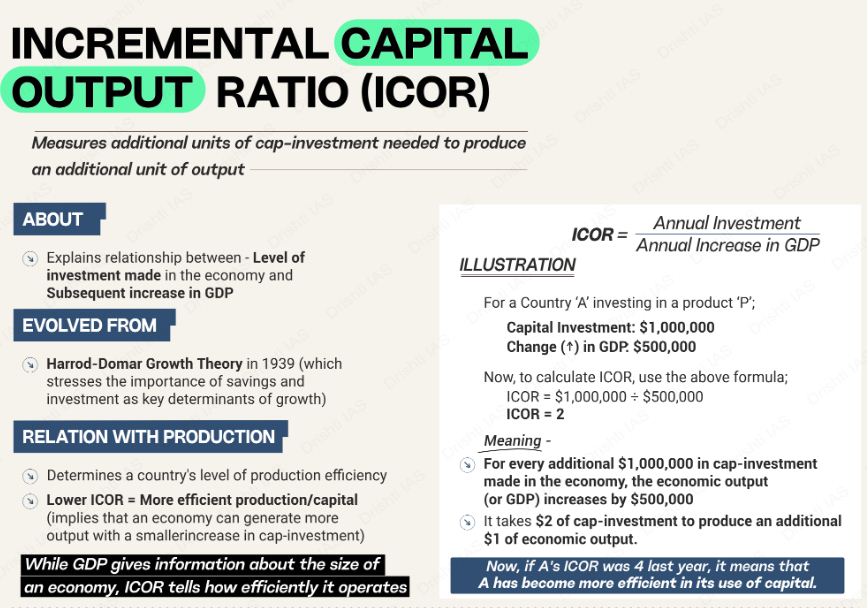
Boosting Productivity (ICOR):
He highlighted the need to improve the efficiency of capital in India.
- ICOR Reduction: India’s Incremental Capital Output Ratio (ICOR)—a measure of how much investment is needed for one unit of growth—has dropped from 5 to 4.5.
- The Goal: He set a medium-term challenge to bring this down to 3, which would mean getting more growth out of every rupee invested.
Factors for Global Competitiveness:
To make India a truly competitive destination, Singh listed three critical pillars:
- Cost of Factors: Reducing the cost of land, labour, and capital.
- Labour Reforms: He praised the recent shift toward a variable-based wage framework as a step toward international best practices.
- Learning from East Asia: He urged India to learn from the “East Asian Tigers” (South Korea, Taiwan, etc.) by treating exports as basic to economic growth rather than just a source of foreign exchange.

October 17, 2025
October 16, 2025
October 6, 2025
September 24, 2025

