December 17, 2025
Daily Current Affairs for UPSC : 17 Dec 2025/Tribes Advisory Councils (TAC):
Governance as a Missing Link in Maoist Insurgency Discourse
The Maoist insurgency, concentrated in India’s Fifth Schedule areas, has often been attributed to underdevelopment, poverty, and socio-economic disparities. However, as highlighted in Niranjan Sahoo’s article (The Hindu, December 2025), a critical yet overlooked factor is poor governance — including administrative neglect, lack of tribal representation, and non-implementation of constitutional safeguards. Recent mass surrenders in Chhattisgarh’s Bastar region (e.g., over 2,100 Maoists surrendering since 2024, with incidents as recent as December 16, 2025, in Bijapur) signal a declining insurgency, offering an opportunity to reimagine governance in these tribal-dominated regions.
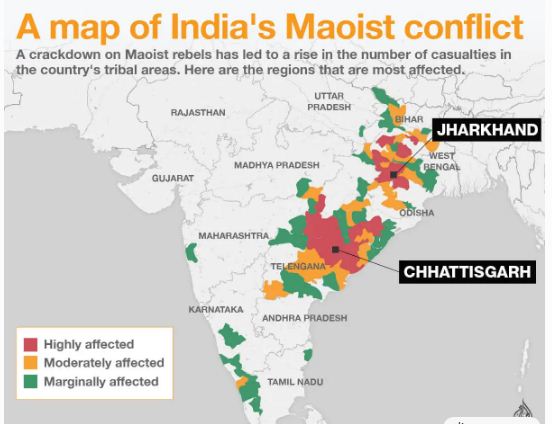
Key Issues in Fifth Schedule Areas
The Fifth Schedule of the Constitution provides special protections for tribal areas, including Tribal Advisory Councils, Governor’s discretionary powers to prevent land alienation, and tribal sub-plans. Yet, successive governments retained colonial-era administrative structures, leading to:
- Land Alienation and Exploitation: Despite safeguards, millions of tribals lost land post-liberalisation, often to mining and development projects (Walter Fernandes’ study).
- Lack of Local Representation: Outsider-dominated bureaucracy and weak institutions (health, education, police, judiciary) fostered alienation. Governors rarely exercised protective powers.
- Violations of PESA (1996): Intended for self-governance via Gram Sabhas, PESA provisions on land acquisition and resource control are routinely flouted, especially in mineral-rich states like Chhattisgarh.
- Parallel Governance by Maoists: In the 1990s-2000s, Maoists filled the vacuum by running ‘Janatan Sarkar’ (people’s government), providing justice, services, and promising ‘Jal, Jungle, Zameen’.
These governance deficits created fertile ground for Maoist mobilisation, beyond mere economic underdevelopment.
Recent Developments: Decline of Insurgency
As of December 2025:
- Violence incidents dropped ~81% from 2010 peak.
- Thousands of surrenders and arrests in 2024-2025, with areas like Abujhmarh declared Maoist-free.
- Government goal: Eliminate LWE by March 2026.
- Improved infrastructure (roads, electricity, digital welfare) and security operations have weakened Maoist hold, but core governance issues persist.
Way Forward: A New Governance Charter
Post-Maoist phase requires:
- Strengthening PESA and Forest Rights Act (2006) implementation, reversing dilutions (e.g., CAF Act 2016).
- Enhancing tribal representation in bureaucracy and local bodies.
- Borrowing from Sixth Schedule model for greater autonomy via District Councils.
- Focus on justice delivery, health, education, and inclusive development to rebuild trust.
- Effective governance, not just security-development duality, is key to preventing resurgence.
About Tribes Advisory Councils (TAC):
- According to the provisions of Paragraph 4, under Article 244(1) of Fifth Schedule of the Constitution of India, the Tribes Advisory Councils (TAC) shall be established in each State having Scheduled Areas therein and, if the President so directs, also in any State having Scheduled Tribes but not Scheduled Areas therein.
- Tribal Advisory Council consists of not more than 20 members, three-fourths shall be the representatives of the Scheduled Tribes in the Legislative Assembly of the State.
- If the condition of seats is not fulfilled: If the number of representatives of the Scheduled Tribes in the Legislative Assembly of the State is less than the number of seats in the Tribes Advisory Council to be filled by such representatives, the remaining seats shall be filled by other members of those tribes.
- It should be established in each state having scheduled areas therein. They are constitutional bodies formed to deal with welfare and advancement of scheduled tribes in states.
- Accordingly, Tribal Advisory Council (TAC) have been constituted in 10 (Ten) states having Scheduled Areas therein namely Andhra Pradesh, Telangana, Chhattisgarh, Gujarat, Himachal Pradesh, Jharkhand, Madhya Pradesh, Maharashtra, Odisha and Rajasthan.
- Further, the States of West Bengal, Tamil Nadu and Uttarakhand not having any notified Scheduled Area also have Tribes Advisory Council constituted therein.
- Accordingly, there is no State (mandated to establish TAC) which have not constituted TAC.
- The Governor may make rules prescribing or regulating, as the case may be,
- The number of members of the Council, the mode of their appointment, and the appointment of the Chairman of the Council and of the officers and servants thereof;
- The conduct of its meetings and its procedure in general, and
- All other incidental matters.
Mains Question :
Governance deficits in Fifth Schedule areas have been a primary enabler of Maoist insurgency rather than mere underdevelopment.” Critically examine

October 17, 2025
October 16, 2025
October 6, 2025
September 24, 2025
