• New Batch: 5 Jan , 2026

January 21, 2026

DAILY LEGAL CURRENT:21 JAN 2026/ABOUT  Uttar Pradesh Subordinate Police Officers (Punishment and Appeal) Rules, 1991:

Why in the News?

On January 19, 2026, three police officers from the Kakori police station—SI Usman Khan, SI Lakhan Singh, and Constable Pushpendra Singh—were suspended following a high-drama incident at the Lucknow Bench of the Allahabad High Court.

The Incident: The officers allegedly entered the High Court campus without authorization to arrest an advocate (Gurfaan Siddiqui) and his client (Amina Khatoon) inside an advocate’s chamber.

The Context: The arrest attempt was related to a case under the UP Prevention of Cow Slaughter Act.

The Reaction: The move was met with immediate outrage by the Bar Association, who viewed it as a direct violation of the “Temple of Justice” and an intimidation of the legal fraternity.

2. Key Points of the Case:

  • Unlawful Entry: The police lacked the required “Gate Pass” or specific permission from the High Court’s Security Registrar to conduct an arrest within the high-security zone.

Criminal Charges: Unlike a standard departmental inquiry, an FIR was registered against the cops under the Bharatiya Nyaya Sanhita (BNS):

Section 329(3): Criminal trespass.

Section 351(3): Criminal intimidation.

Section 352: Provocation with intent to cause breach of peace.

  • Suspension Clause: They were suspended under Rule 17(1)(a) of the UP Subordinate Police Officers (Punishment and Appeal) Rules, 1991, which allows for suspension during a pending inquiry for serious misconduct.

3. Legal & Constitutional Provisions:

This incident touches upon several critical legal frameworks regarding the separation of powers and the protection of legal professionals.

A. Bharatiya Nyaya Sanhita (BNS) & BNSS:

  • Sanctity of Chambers: A lawyer’s chamber is considered a private extension of the judicial workspace. Unauthorised entry with the intent to “annoy or intimidate” constitutes Criminal Trespass.

Arrest Procedure: Under the Bharatiya Nagarik Suraksha Sanhita (BNSS), police must follow strict protocols for arrests, especially when the person is under the protection of legal counsel.

B. Constitutional Protections:

  • Article 21: Protection of Life and Personal Liberty. The Supreme Court has repeatedly held that “procedure established by law” for arrest must be fair and non-arbitrary.
  • Article 22: Right to consult and be defended by a legal practitioner of one’s choice. Entering a court to arrest a client while they are consulting their lawyer is seen as a violation of this right.

Related Case Law & Precedents:

The judiciary has historically been very protective of its premises to ensure that litigants and lawyers can attend court without fear of arbitrary detention.
  • K. Basu vs. State of West Bengal: The landmark judgment that laid down the “11 Commandments” of arrest. The Lucknow cops failed to disclose their identity properly and didn’t provide memo details during the attempted “campus arrest.”
  • Pratibha Pawar vs. State of Maharashtra: Courts have held that while court premises don’t provide “absolute immunity” from arrest for criminals, the police must inform the presiding officer or the Registrar before conducting such an operation to maintain the dignity of the court.
  • Supreme Court Bar Association vs. Union of India: Stressed that the independence of the legal profession is a fundamental pillar of the justice system; police intimidation of lawyers within court grounds is a “contemptuous” act.


ABOUT  Uttar Pradesh Subordinate Police Officers (Punishment and Appeal) Rules, 1991:

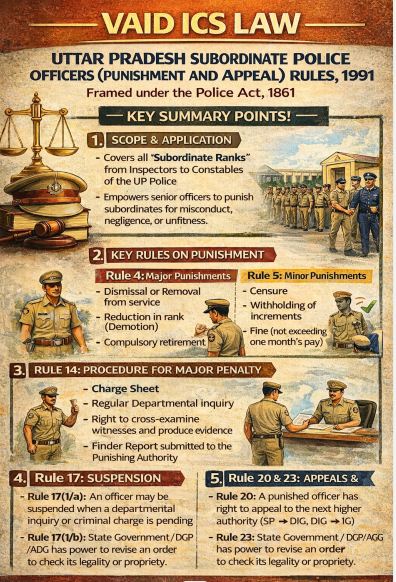
The Uttar Pradesh Subordinate Police Officers (Punishment and Appeal) Rules, 1991 were framed under the Police Act, 1861. They provide the legal framework for maintaining discipline and conducting departmental inquiries against non-gazetted police officers (from Constables to Sub-Inspectors) in Uttar Pradesh.

Scope and Application

  • Applicability: These rules apply to all “Subordinate Ranks” of the UP Police (Inspectors, Sub-Inspectors, Assistant Sub-Inspectors, Head Constables, and Constables).
  • Authority: The rules empower senior officers (SP, DIG, IG) to punish subordinates for misconduct, negligence, or unfitness.

Key Rules on Punishment

The rules categorize punishments into two types:

  • Rule 4: Major Punishments
    • Dismissal or Removal from service.
    • Reduction in rank (Demotion).
    • Compulsory retirement.
  • Rule 5: Minor Punishments
    • Censure (a formal entry of dissatisfaction in the service record).
    • Withholding of increments.
    • Fine (not exceeding one month’s pay).
    • Fatigue duty (for Constables).

Rule 14: Procedure for Major Penalty:

This is the most critical procedural section.

  • It mandates a Regular Departmental Inquiry.
  • The officer must be given a Charge Sheet with specific allegations.
  • The accused has the right to cross-examine witnesses and produce evidence in their defense.
  • A “Finding Report” is prepared by the Inquiry Officer and submitted to the Punishing Authority.

Rule 17: Suspension

This rule governs the temporary removal of an officer from active duty.

  • Rule 17(1)(a): An officer can be suspended when a departmental inquiry or a criminal charge is contemplated or pending.
  • Rule 17(1)(b): Suspension is mandatory if the officer is detained in custody for more than 48 hours.
  • Status: While under suspension, the officer is not “fired” but is barred from duty and receives a “Subsistence Allowance.”

Rule 20 & 23: Appeals and Revisions

  • Rule 20 (Appeal): An officer punished under these rules has the right to appeal to the next higher authority (e.g., if the SP punishes, the appeal goes to the DIG).
  • Rule 23 (Revision): The State Government or a high-ranking officer (DGP/ADG) can call for the records of any case to check the legality or propriety of an order, even if no appeal was filed.

Rule 24: Time Limit

  • The rules generally stipulate that an appeal must be filed within 90 days of the punishment order.


Get In Touch

B-36, Sector-C Aliganj – Near Aliganj Post Office Lucknow – 226024 (U.P.) India

+91 8858209990, +91 9415011892

lucknowvaidsics@gmail.com / drpmtripathi.lucknow@gmail.com

UPSC INFO
Reach Us
Our Location

Google Play

About Us

VAIDS ICS Lucknow, a leading Consultancy for Civil Services & Judicial Services, was started in 1988 to provide expert guidance, consultancy, and counseling to aspirants for a career in Civil Services & Judicial Services.

The Civil Services (including the PCS) and the PCS (J) attract some of the best talented young persons in our country. The sheer diversity of work and it’s nature, the opportunity to serve the country and be directly involved in nation-building, makes the bureaucracy the envy of both-the serious and the adventurous. Its multi-tiered (Prelims, Mains & Interview) examination is one of the most stringent selection procedures. VAID’S ICS Lucknow, from its inception, has concentrated on the requirements of the civil services aspirants. The Institute expects, and helps in single-minded dedication and preparation.

© 2023, VAID ICS. All rights reserved. Designed by SoftFixer.com