Article 21 of the Constitution: Expanding Scope of Right to Life and Personal Liberty
Why in News? The Fifth Annual Samvaad organised by the Justice Ajay Kumar Tripathi Foundation on 21 November 2026 in New Delhi discussed the evolving interpretation of Article 21 and the challenges in ensuring the effective implementation of fundamental rights.
The discussion focused on whether the expanding scope of Article 21 represents constitutional expansion or constitutional interpretation, and whether the State lacks the capacity or willingness to implement these rights.
Key Participants:
- Justice Madan B. Lokur: Former Judge of the Supreme Court.
- Raju Ramachandran: Senior Advocate.
- K. Mishra: Former Union Government Secretary.
- Mamta Tiwari: Senior Advocate and moderator.
Article 21: Constitutional Provision:
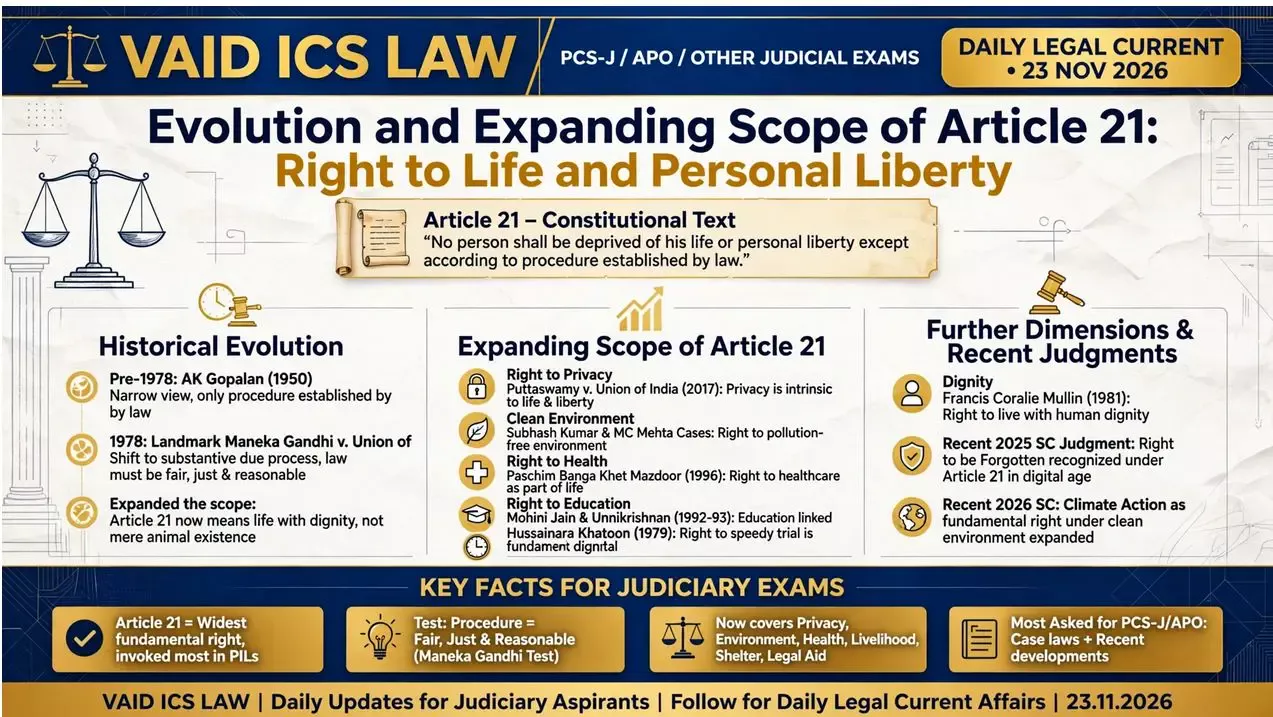
Article 21 states:
“No person shall be deprived of his life or personal liberty except according to procedure established by law.”
Key Features:
- Article 21 is available to every person, including citizens and foreigners.
- It protects the right to life and personal liberty.
- It places restrictions on arbitrary State action.
- The Supreme Court has interpreted it broadly to ensure a life of dignity, freedom and meaningful existence.
Evolution and Expanding Scope of Article 21:
Through judicial interpretation, the Supreme Court has recognised several rights as essential components of the right to life.
Important Rights Recognised Under Article 21:
- Right to Live with Human Dignity: Life means more than mere physical existence; it includes conditions necessary for a dignified life.
- Right to Livelihood: The ability to earn a livelihood is an essential component of the right to life.
- Right to Health: Access to healthcare and medical assistance forms an important part of Article 21.
- Right to Privacy: Protects individuals against unjustified interference in their private lives.
- Right to a Clean Environment: A clean and healthy environment is necessary for meaningful human existence.
- Right to Food: Access to adequate food and protection against hunger are linked to the right to life.
- Right to Education: Recognised as part of Article 21; subsequently, Article 21A expressly guaranteed free and compulsory education for children aged 6–14 years.
Major Issues Discussed During the Samvaad:
Constitutional Expansion or Constitutional Interpretation:
Raju Ramachandran argued that the evolution of Article 21 should be understood as constitutional interpretation rather than constitutional expansion.
- Courts have interpreted the meaning of the right to life in the light of changing social and economic conditions.
- The Directive Principles of State Policy (Part IV) provide important guidance for interpreting the right to life.
- Courts have given substantive meaning to Article 21 where the State has failed to fulfil its constitutional welfare obligations.
- Courts should not withdraw from their constitutional responsibilities merely because the government is slow in implementing fundamental rights.
- Such withdrawal would amount to constitutional abdication, meaning failure to perform a constitutional responsibility.
State Capacity vs State Willingness:
A major issue was whether the failure to implement fundamental rights results from inadequate administrative capacity or a lack of political and institutional willingness.
Justice Madan B. Lokur’s View:
- Constitutional rights must have practical meaning in the lives of ordinary people.
- He referred to cases concerning food security, widows’ welfare in Vrindavan, child protection and manual scavenging.
- He also highlighted difficulties in implementing social welfare measures, including the timely payment of MGNREGA wages.
- These examples demonstrate the gap between constitutional guarantees and the actual conditions of vulnerable sections.
- The right to live with dignity cannot remain merely an abstract constitutional promise.
- Both State willingness and administrative capacity are necessary for effective implementation.
C.K. Mishra’s View:
- He acknowledged the State’s responsibility to implement constitutionally recognised rights.
- However, he distinguished between the willingness to implement rights and the practical ability to deliver them.
- Effective implementation requires adequate administrative capacity, proper prioritisation and coordination among different government departments.
- The State must develop institutional mechanisms to translate constitutional guarantees into actual public services.
Emerging Dimensions of Article 21:
The discussion highlighted several contemporary issues that require attention under the framework of Article 21.
- Mental Health: Access to mental healthcare and protection of mental well-being.
- Inclusive Digital Access: Ensuring that digital services do not exclude disadvantaged and vulnerable groups.
- Menstrual Dignity: Access to menstrual hygiene, sanitation and related facilities.
- Climate Change: Protection against environmental conditions that threaten life and health.
- Safe Public Footpaths: Ensuring safe and accessible pedestrian infrastructure, particularly for vulnerable persons.
Constitutional Significance of Article 21:
- Transformative Constitutionalism: Article 21 enables the Constitution to respond to changing social realities.
- Substantive Justice: It ensures that fundamental rights are meaningful in practice, not merely available on paper.
- Social Welfare: It strengthens the constitutional responsibility of the State towards weaker and vulnerable sections.
- Judicial Accountability: It enables courts to examine State action and inaction affecting fundamental rights.
- Human Dignity: It places individual dignity at the centre of constitutional governance.
Way Forward:
- Strengthen administrative and institutional capacity for effective implementation of fundamental rights.
- Ensure accountability of public authorities for failure to deliver essential services.
- Improve coordination among government departments.
- Prioritise vulnerable sections in the implementation of welfare schemes.
- Strengthen access to healthcare, food security, sanitation and digital services.
- Maintain an effective balance between judicial intervention and executive responsibility.
Conclusion:
Article 21 has evolved from a narrow protection against arbitrary deprivation of life and personal liberty into a broad constitutional guarantee of dignified human existence. However, its real success depends not merely on judicial interpretation but also on the State’s willingness, administrative capacity and institutional commitment to translate constitutional rights into reality.
Medical Evidence of Genital Manipulation Alone Cannot Establish Penetrative Sexual Assault: Gauhati High Court
Why in News? The Gauhati High Court, in a recent judgment dated 23 November 2026, held that evidence of genital manipulation alone cannot conclusively establish aggravated penetrative sexual assault under the Protection of Children from Sexual Offences (POCSO) Act, 2012, unless supported by sufficient evidence establishing penetration.
The Court modified the accused’s conviction from Section 6 to Section 10 of the POCSO Act, while maintaining the finding of aggravated sexual assault.
Case Details:
- Court: Gauhati High Court.
- Bench: Justice Michael Zothankhuma and Justice Sanjeev Kumar Sharma.
- Incident: 5 March 2024.
- Victim: A seven-year-old girl.
- Relevant Law: Protection of Children from Sexual Offences (POCSO) Act, 2012.

Background of the Case:
- The accused allegedly took a seven-year-old girl inside his house and sexually assaulted her.
- Subsequently, the victim’s family found her inside the accused’s house in a partially undressed condition.
- The medical examination revealed redness around the victim’s vulva and a fresh tear in the fourchette (the area near the vaginal opening).
- However, the hymen was intact and no spermatozoa were detected.
- The medical officer found no evidence of recent sexual intercourse but observed signs of recent genital manipulation.
- The Special POCSO Court convicted the accused under Section 6 of the POCSO Act, relating to aggravated penetrative sexual assault.
- The accused challenged this conviction before the Gauhati High Court.
Arguments Before the High Court:
Arguments of the Accused:
- The victim had given different accounts regarding the nature of penetration.
- Before the Magistrate, she referred to the insertion of a finger into her vagina, whereas her statement before the medical officer referred to penile penetration.
- The medical evidence did not conclusively establish that penetration had taken place.
- Therefore, conviction under Section 6 was not justified.
Observations of the Gauhati High Court:
- The Court observed that the allegation of penile penetration could not be sustained on the available evidence.
- The prosecution failed to establish that the injuries found during medical examination could have resulted only from penetration.
- No sufficient medical evidence or medical literature was produced to conclusively establish penetration.
- Therefore, the benefit of doubt regarding the charge of penetrative sexual assault had to be given to the accused.
Important Observation Regarding the Accused’s Statement:
- The accused had admitted before the medical officer that he had undressed the victim and touched her vulva and vagina, while denying penetration.
- The High Court treated this statement as an extra-judicial confession, which corroborated the victim’s testimony.
- Thus, although penetrative sexual assault was not established, the evidence was sufficient to establish aggravated sexual assault.
Final Decision of the Court:
The Gauhati High Court partly allowed the appeal and modified the conviction as follows:
| Particulars |
Decision |
| Original conviction |
Section 6, POCSO Act |
| Modified conviction |
Section 10, POCSO Act |
| Sentence |
7 years of rigorous imprisonment |
| Fine |
₹15,000 |
| Compensation |
Fine amount to be paid to the victim |
| Default in payment |
2 months of simple imprisonment |
Relevant Legal Provisions: POCSO Act, 2012
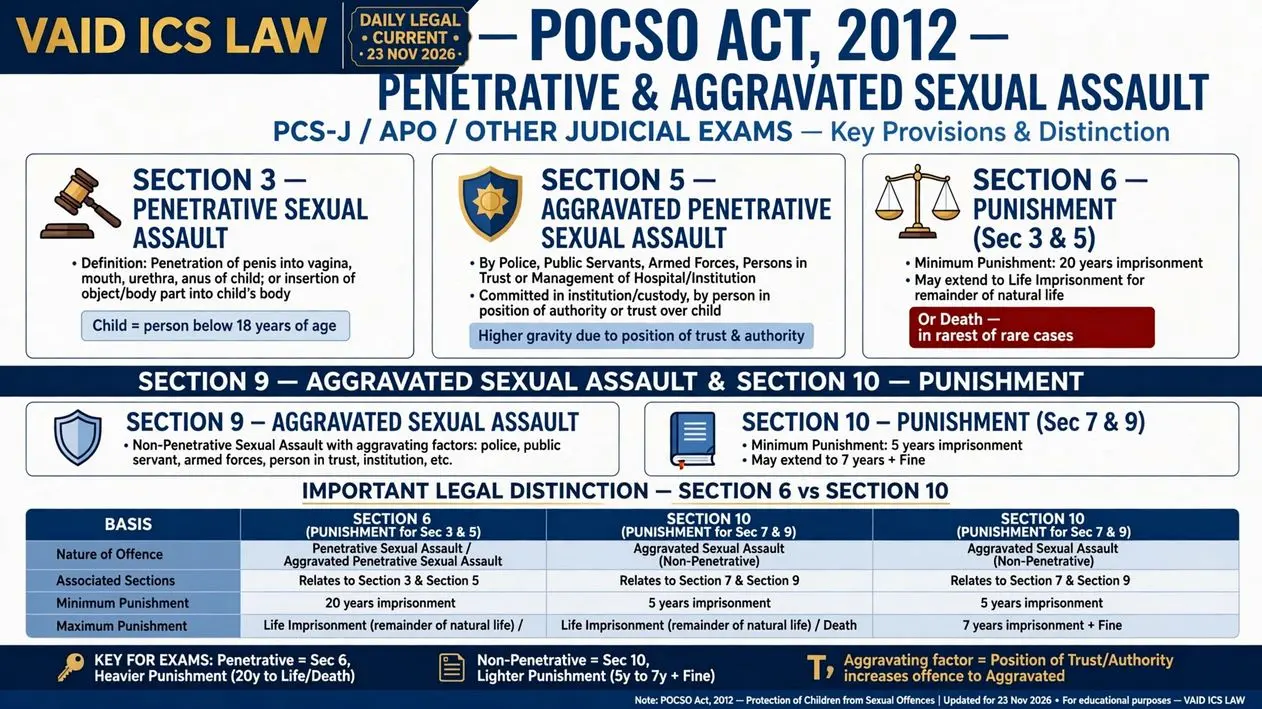
Section 3 – Penetrative Sexual Assault:
A person commits penetrative sexual assault if the person performs any of the acts specified under this section, including:
- Penetration of the penis into the vagina, mouth, urethra or anus of a child.
- Insertion of any object or any part of the body other than the penis into the vagina, urethra or anus of a child.
- Manipulation of any part of the body of a child to cause penetration into the vagina, urethra, anus or any part of the body of the child.
Section 5 – Aggravated Penetrative Sexual Assault:
This provision identifies circumstances in which penetrative sexual assault becomes aggravated, including commission of the offence by specified persons such as police officers, public servants, armed forces personnel, persons in positions of trust or authority, and other circumstances specified under the section.
Section 6 – Punishment for Aggravated Penetrative Sexual Assault:
Provides punishment for aggravated penetrative sexual assault under Section 5.
- Minimum imprisonment: 20 years.
- May extend to imprisonment for life, meaning imprisonment for the remainder of the person’s natural life, or death.
Section 9 – Aggravated Sexual Assault:
Identifies circumstances in which sexual assault under Section 7 becomes aggravated.
Section 10 – Punishment for Aggravated Sexual Assault:
Provides punishment for aggravated sexual assault.
- Minimum imprisonment: 5 years.
- May extend to 7 years.
- Fine is also prescribed.
Important Legal Distinction:
| Section 6 |
Section 10 |
| Punishment for aggravated penetrative sexual assault. |
Punishment for aggravated sexual assault without the requirement of establishing penetrative sexual assault. |
| Relates to Sections 3 and 5. |
Relates to Sections 7 and 9. |
| Minimum punishment is 20 years. |
Minimum punishment is 5 years. |
Legal Significance:
- Burden of Proof: The prosecution must establish the ingredients of the particular offence charged through legally admissible evidence.
- Medical Evidence: Medical findings must be evaluated along with the testimony of the victim and other evidence.
- Benefit of Doubt: Where penetration is not established beyond reasonable doubt, the accused is entitled to the benefit of doubt regarding the charge of penetrative sexual assault.
- Distinction Between Offences: Penetrative sexual assault and sexual assault are separate offences under the POCSO Act and have different legal ingredients and punishments.
- Protection of Children: Failure to establish penetration does not automatically mean that no sexual offence has occurred. Other forms of sexual assault may still be established through available evidence.
Conclusion:
The judgment reiterates the importance of distinguishing between aggravated penetrative sexual assault under Section 6 and aggravated sexual assault under Section 10 of the POCSO Act. The prosecution must establish the essential ingredients of the offence charged. At the same time, failure to prove penetration does not exclude criminal liability where the evidence establishes another sexual offence under the Act.
केवल जननांगों के साथ छेड़छाड़ से भेदक लैंगिक हमला सिद्ध नहीं होता: गुवाहाटी उच्च न्यायालय
चर्चा में क्यों? गुवाहाटी उच्च न्यायालय ने एक हालिया निर्णय में कहा कि केवल जननांगों के साथ छेड़छाड़ (Genital Manipulation) के चिकित्सकीय साक्ष्य के आधार पर लैंगिक अपराधों से बालकों का संरक्षण अधिनियम, 2012 (POCSO Act) के अंतर्गत गंभीर भेदक लैंगिक हमला (Aggravated Penetrative Sexual Assault) सिद्ध नहीं किया जा सकता, जब तक कि पर्याप्त साक्ष्यों से प्रवेश (Penetration) स्थापित न हो जाए।
न्यायालय ने अभियुक्त की दोषसिद्धि को धारा 6 से परिवर्तित करके धारा 10 के अंतर्गत कर दिया तथा गंभीर लैंगिक हमले के लिए दोषसिद्धि को बरकरार रखा।
मामले का विवरण:
- न्यायालय: गुवाहाटी उच्च न्यायालय।
- पीठ: न्यायमूर्ति माइकल जोथमखुमा एवं न्यायमूर्ति संजीव कुमार शर्मा।
- घटना की तिथि: 5 मार्च 2024।
- पीड़िता: सात वर्षीय बालिका।
- संबंधित कानून: लैंगिक अपराधों से बालकों का संरक्षण अधिनियम, 2012।
मामले की पृष्ठभूमि:
- अभियुक्त कथित रूप से सात वर्षीय बालिका को अपने घर के अंदर ले गया और उसके साथ लैंगिक दुर्व्यवहार किया।
- बाद में पीड़िता के परिजनों ने उसे अभियुक्त के घर में आंशिक रूप से निर्वस्त्र अवस्था में पाया।
- चिकित्सकीय परीक्षण में पीड़िता के भगोष्ठ (Vulva) के आसपास लालिमा तथा योनि द्वार के निकट स्थित भाग (Fourchette) में ताजा चोट पाई गई।
- हालाँकि, योनिच्छद (Hymen) अक्षत था तथा वीर्याणु (Spermatozoa) नहीं पाए गए।
- चिकित्साधिकारी को हालिया संभोग का कोई प्रमाण नहीं मिला, लेकिन जननांगों के साथ हालिया छेड़छाड़ के संकेत पाए गए।
- विशेष पॉक्सो न्यायालय ने अभियुक्त को पॉक्सो अधिनियम की धारा 6 के अंतर्गत गंभीर भेदक लैंगिक हमले का दोषी ठहराया।
- अभियुक्त ने इस दोषसिद्धि को गुवाहाटी उच्च न्यायालय में चुनौती दी।
उच्च न्यायालय के समक्ष पक्षकारों के तर्क:
अभियुक्त के तर्क:
- पीड़िता ने प्रवेश की प्रकृति के संबंध में अलग-अलग बयान दिए थे।
- मजिस्ट्रेट के समक्ष उसने योनि में उँगली डालने की बात कही, जबकि चिकित्साधिकारी के समक्ष दिए गए कथन में शिश्न द्वारा प्रवेश का उल्लेख था।
- चिकित्सकीय साक्ष्य से प्रवेश की घटना निर्णायक रूप से स्थापित नहीं होती थी।
- अतः धारा 6 के अंतर्गत दोषसिद्धि उचित नहीं थी।
गुवाहाटी उच्च न्यायालय की प्रमुख टिप्पणियाँ:
- न्यायालय ने माना कि उपलब्ध साक्ष्यों के आधार पर शिश्न द्वारा प्रवेश का आरोप सिद्ध नहीं किया जा सका।
- अभियोजन पक्ष यह स्थापित करने में विफल रहा कि चिकित्सकीय परीक्षण में पाई गई चोटें केवल प्रवेश के कारण ही उत्पन्न हो सकती थीं।
- प्रवेश को निर्णायक रूप से सिद्ध करने के लिए पर्याप्त चिकित्सकीय साक्ष्य अथवा चिकित्सकीय साहित्य प्रस्तुत नहीं किया गया।
- इसलिए भेदक लैंगिक हमले के आरोप के संबंध में अभियुक्त को संदेह का लाभ (Benefit of Doubt) दिया जाना आवश्यक था।
अभियुक्त के कथन के संबंध में महत्त्वपूर्ण टिप्पणी:
- अभियुक्त ने चिकित्साधिकारी के समक्ष स्वीकार किया था कि उसने पीड़िता के कपड़े उतारे तथा उसके भगोष्ठ और योनि को स्पर्श किया था, लेकिन प्रवेश करने से इनकार किया था।
- उच्च न्यायालय ने इस कथन को न्यायालयेतर संस्वीकृति (Extra-Judicial Confession) माना, जिसे पीड़िता की गवाही से पुष्टिकरण प्राप्त हुआ।
- इस प्रकार, यद्यपि भेदक लैंगिक हमला सिद्ध नहीं हुआ, तथापि उपलब्ध साक्ष्य गंभीर लैंगिक हमला सिद्ध करने के लिए पर्याप्त थे।
न्यायालय का अंतिम निर्णय:
गुवाहाटी उच्च न्यायालय ने अपील को आंशिक रूप से स्वीकार करते हुए दोषसिद्धि में निम्नलिखित परिवर्तन किया:
| विवरण |
न्यायालय का निर्णय |
| मूल दोषसिद्धि |
पॉक्सो अधिनियम की धारा 6 |
| परिवर्तित दोषसिद्धि |
पॉक्सो अधिनियम की धारा 10 |
| कारावास |
7 वर्ष का सश्रम कारावास |
| जुर्माना |
₹15,000 |
| प्रतिकर |
जुर्माने की राशि पीड़िता को प्रदान की जाएगी |
| जुर्माना अदा न करने पर |
2 माह का साधारण कारावास |
संबंधित विधिक प्रावधान: लैंगिक अपराधों से बालकों का संरक्षण अधिनियम, 2012
धारा 3 – भेदक लैंगिक हमला (Penetrative Sexual Assault):
इस धारा के अनुसार, कोई व्यक्ति निम्नलिखित में से कोई कार्य करता है, तो वह भेदक लैंगिक हमला करता है:
- बालक की योनि, मुख, मूत्रमार्ग अथवा गुदा में अपने शिश्न का प्रवेश करना।
- बालक की योनि, मूत्रमार्ग अथवा गुदा में किसी वस्तु अथवा शिश्न के अतिरिक्त शरीर के किसी अन्य अंग का प्रवेश करना।
- बालक के शरीर के किसी भाग में प्रवेश कराने के उद्देश्य से उसके शरीर के किसी भाग का इस प्रकार संचालन करना कि योनि, मूत्रमार्ग, गुदा अथवा शरीर के किसी भाग में प्रवेश हो।
धारा 5 – गंभीर भेदक लैंगिक हमला (Aggravated Penetrative Sexual Assault):
यह धारा उन परिस्थितियों का उल्लेख करती है, जिनमें भेदक लैंगिक हमला गंभीर प्रकृति का हो जाता है।
इनमें निम्नलिखित परिस्थितियाँ शामिल हैं:
- पुलिस अधिकारी द्वारा अपराध किया जाना।
- लोक सेवक द्वारा अपराध किया जाना।
- सशस्त्र बलों के किसी सदस्य द्वारा अपराध किया जाना।
- विश्वास अथवा प्राधिकार की स्थिति में विद्यमान व्यक्ति द्वारा अपराध किया जाना।
- इस धारा में उल्लिखित अन्य गंभीर परिस्थितियों में अपराध किया जाना।
धारा 6 – गंभीर भेदक लैंगिक हमले के लिए दंड:
यह धारा धारा 5 के अंतर्गत परिभाषित गंभीर भेदक लैंगिक हमले के लिए दंड का प्रावधान करती है।
- न्यूनतम कारावास: 20 वर्ष।
- अधिकतम दंड: आजीवन कारावास, जिसका अर्थ व्यक्ति के शेष प्राकृतिक जीवनकाल तक कारावास है, अथवा मृत्युदंड।
धारा 9 – गंभीर लैंगिक हमला (Aggravated Sexual Assault):
यह धारा उन परिस्थितियों का उल्लेख करती है, जिनमें धारा 7 के अंतर्गत लैंगिक हमला गंभीर लैंगिक हमला बन जाता है।
धारा 10 – गंभीर लैंगिक हमले के लिए दंड:
यह धारा धारा 9 के अंतर्गत परिभाषित गंभीर लैंगिक हमले के लिए दंड का प्रावधान करती है।
- न्यूनतम कारावास: 5 वर्ष।
- अधिकतम कारावास: 7 वर्ष।
- इसके अतिरिक्त जुर्माने का भी प्रावधान है।
महत्त्वपूर्ण विधिक अंतर:
| धारा 6 |
धारा 10 |
| गंभीर भेदक लैंगिक हमले के लिए दंड का प्रावधान। |
गंभीर लैंगिक हमले के लिए दंड का प्रावधान। |
| धारा 3 एवं धारा 5 से संबंधित। |
धारा 7 एवं धारा 9 से संबंधित। |
| न्यूनतम दंड 20 वर्ष का कारावास। |
न्यूनतम दंड 5 वर्ष का कारावास। |
| भेदक लैंगिक हमले के आवश्यक तत्त्वों का सिद्ध होना आवश्यक। |
भेदक प्रवेश सिद्ध करना आवश्यक नहीं; धारा 7 एवं 9 के आवश्यक तत्त्व सिद्ध होने चाहिए। |
निर्णय का विधिक महत्त्व:
- प्रमाण का भार: अभियोजन पक्ष को आरोपित अपराध के आवश्यक विधिक तत्त्वों को विधि के अनुसार ग्राह्य साक्ष्यों से सिद्ध करना होगा।
- चिकित्सकीय साक्ष्य: चिकित्सकीय निष्कर्षों का मूल्यांकन पीड़िता की गवाही तथा अन्य उपलब्ध साक्ष्यों के साथ किया जाना चाहिए।
- संदेह का लाभ: यदि अभियोजन पक्ष युक्तियुक्त संदेह से परे प्रवेश सिद्ध करने में विफल रहता है, तो अभियुक्त को भेदक लैंगिक हमले के आरोप के संबंध में संदेह का लाभ प्राप्त होगा।
- अपराधों के बीच अंतर: भेदक लैंगिक हमला तथा लैंगिक हमला पॉक्सो अधिनियम के अंतर्गत अलग-अलग अपराध हैं। इनके आवश्यक विधिक तत्त्व एवं दंड भी अलग-अलग हैं।
- बालकों का संरक्षण: प्रवेश सिद्ध न हो पाने का अर्थ यह नहीं है कि कोई लैंगिक अपराध हुआ ही नहीं। उपलब्ध साक्ष्यों के आधार पर अधिनियम के अंतर्गत लैंगिक हमले का अन्य अपराध सिद्ध किया जा सकता है।
निष्कर्ष:
यह निर्णय पॉक्सो अधिनियम की धारा 6 के अंतर्गत गंभीर भेदक लैंगिक हमले तथा धारा 10 के अंतर्गत गंभीर लैंगिक हमले के बीच अंतर को स्पष्ट करता है। अभियोजन पक्ष के लिए आरोपित अपराध के आवश्यक तत्त्वों को सिद्ध करना अनिवार्य है। साथ ही, प्रवेश सिद्ध न होने पर भी यदि उपलब्ध साक्ष्यों से अधिनियम के अंतर्गत अन्य लैंगिक अपराध सिद्ध होता है, तो अभियुक्त की आपराधिक दायित्व से मुक्ति नहीं होती।
संविधान का अनुच्छेद 21: जीवन एवं व्यक्तिगत स्वतंत्रता के अधिकार का विस्तृत दायरा
चर्चा में क्यों? न्यायमूर्ति अजय कुमार त्रिपाठी फाउंडेशन द्वारा 21 नवंबर 2026 को नई दिल्ली में आयोजित पाँचवें वार्षिक संवाद (सम्वाद) में संविधान के अनुच्छेद 21 की विकसित होती व्याख्या तथा मौलिक अधिकारों को वास्तविक रूप से लागू करने की चुनौतियों पर चर्चा की गई।
चर्चा का प्रमुख विषय यह था कि अनुच्छेद 21 के विस्तृत होते दायरे को संवैधानिक विस्तार अथवा संवैधानिक निर्वचन के रूप में समझा जाना चाहिए तथा मौलिक अधिकारों के प्रभावी क्रियान्वयन में राज्य की प्रशासनिक क्षमता और इच्छाशक्ति की क्या भूमिका है।
प्रमुख प्रतिभागी:
- न्यायमूर्ति मदन बी. लोकुर: उच्चतम न्यायालय के पूर्व न्यायाधीश।
- राजू रामचंद्रन: वरिष्ठ अधिवक्ता।
- सी.के. मिश्रा: भारत सरकार के पूर्व सचिव।
- ममता तिवारी: वरिष्ठ अधिवक्ता एवं चर्चा की संचालक।
अनुच्छेद 21: संवैधानिक प्रावधान:
अनुच्छेद 21 के अनुसार:
“किसी व्यक्ति को उसके प्राण या दैहिक स्वतंत्रता से विधि द्वारा स्थापित प्रक्रिया के अनुसार ही वंचित किया जाएगा, अन्यथा नहीं।”
प्रमुख विशेषताएँ:
- अनुच्छेद 21 का संरक्षण प्रत्येक व्यक्ति को प्राप्त है, चाहे वह भारतीय नागरिक हो अथवा विदेशी।
- यह जीवन और व्यक्तिगत स्वतंत्रता के अधिकार की रक्षा करता है।
- यह राज्य की मनमानी कार्रवाई के विरुद्ध संवैधानिक संरक्षण प्रदान करता है।
- उच्चतम न्यायालय ने इसकी व्यापक व्याख्या करते हुए गरिमापूर्ण, स्वतंत्र एवं सार्थक जीवन के अधिकार को मान्यता दी है।
अनुच्छेद 21 का विकास एवं विस्तृत क्षेत्र:
न्यायिक निर्वचन के माध्यम से उच्चतम न्यायालय ने अनेक अधिकारों को जीवन के अधिकार के आवश्यक अंग के रूप में मान्यता प्रदान की है।
अनुच्छेद 21 के अंतर्गत मान्यता प्राप्त प्रमुख अधिकार:
- मानवीय गरिमा के साथ जीवन का अधिकार: जीवन का अर्थ केवल शारीरिक अस्तित्व नहीं, बल्कि सम्मानजनक जीवन जीने के लिए आवश्यक परिस्थितियों की उपलब्धता भी है।
- आजीविका का अधिकार: आजीविका अर्जित करने के अवसर जीवन के अधिकार का आवश्यक अंग हैं।
- स्वास्थ्य का अधिकार: स्वास्थ्य सेवाओं एवं आवश्यक चिकित्सा सहायता तक पहुँच जीवन के अधिकार का महत्वपूर्ण हिस्सा है।
- निजता का अधिकार: व्यक्ति के निजी जीवन में अनुचित हस्तक्षेप से संरक्षण प्रदान करता है।
- स्वच्छ पर्यावरण का अधिकार: स्वस्थ एवं स्वच्छ पर्यावरण सार्थक जीवन के लिए आवश्यक है।
- भोजन का अधिकार: पर्याप्त भोजन की उपलब्धता तथा भुखमरी से संरक्षण जीवन के अधिकार से संबंधित हैं।
- शिक्षा का अधिकार: शिक्षा को अनुच्छेद 21 के अंतर्गत मान्यता दी गई तथा बाद में अनुच्छेद 21-क के माध्यम से 6 से 14 वर्ष के बच्चों के लिए निःशुल्क एवं अनिवार्य शिक्षा का स्पष्ट मौलिक अधिकार प्रदान किया गया।
सम्वाद के दौरान चर्चा के प्रमुख विषय:
संवैधानिक विस्तार अथवा संवैधानिक निर्वचन:
वरिष्ठ अधिवक्ता राजू रामचंद्रन ने तर्क दिया कि अनुच्छेद 21 के विकास को संवैधानिक विस्तार के बजाय संवैधानिक निर्वचन (Constitutional Interpretation) के रूप में समझना अधिक उचित है।
- न्यायालयों ने बदलती सामाजिक एवं आर्थिक परिस्थितियों के अनुरूप जीवन के अधिकार का व्यापक अर्थ निर्धारित किया है।
- संविधान के भाग IV में वर्णित राज्य के नीति-निदेशक तत्त्व अनुच्छेद 21 की व्याख्या के लिए महत्वपूर्ण मार्गदर्शन प्रदान करते हैं।
- जहाँ राज्य नागरिकों के कल्याण से संबंधित अपने संवैधानिक दायित्वों को पूरा करने में विफल रहता है, वहाँ न्यायालयों ने अनुच्छेद 21 को वास्तविक अर्थ प्रदान किया है।
- केवल इस आधार पर कि राज्य मौलिक अधिकारों के क्रियान्वयन में विलंब कर रहा है, न्यायालय अपने संवैधानिक दायित्व से पीछे नहीं हट सकते।
- ऐसा करना संवैधानिक दायित्वों से विमुखता (Constitutional Abdication) के समान होगा।
राज्य की क्षमता बनाम राज्य की इच्छाशक्ति:
चर्चा का एक प्रमुख विषय यह था कि मौलिक अधिकारों के क्रियान्वयन में विफलता का कारण राज्य की अपर्याप्त प्रशासनिक क्षमता है अथवा कार्य करने की इच्छाशक्ति का अभाव।
न्यायमूर्ति मदन बी. लोकुर का दृष्टिकोण:
- संविधान द्वारा प्रदत्त अधिकारों का सामान्य नागरिकों के जीवन में व्यावहारिक प्रभाव दिखाई देना चाहिए।
- उन्होंने खाद्य सुरक्षा, वृंदावन में विधवाओं के कल्याण, बाल संरक्षण तथा हाथ से मैला उठाने की प्रथा से संबंधित मामलों का उल्लेख किया।
- उन्होंने मनरेगा के अंतर्गत मजदूरी के समय पर भुगतान सहित विभिन्न सामाजिक कल्याणकारी योजनाओं के क्रियान्वयन में आने वाली समस्याओं पर भी प्रकाश डाला।
- ये उदाहरण संवैधानिक रूप से मान्यता प्राप्त गरिमा के अधिकार तथा कमजोर वर्गों की वास्तविक जीवन परिस्थितियों के बीच विद्यमान अंतर को दर्शाते हैं।
- गरिमापूर्ण जीवन का अधिकार केवल एक सैद्धांतिक संवैधानिक घोषणा बनकर नहीं रहना चाहिए।
- अधिकारों के प्रभावी क्रियान्वयन के लिए राज्य की इच्छाशक्ति और प्रशासनिक क्षमता दोनों आवश्यक हैं।
सी.के. मिश्रा का दृष्टिकोण:
- उन्होंने संवैधानिक रूप से मान्यता प्राप्त अधिकारों को सुनिश्चित करने के लिए राज्य के दायित्व को स्वीकार किया।
- हालाँकि, उन्होंने अधिकारों को लागू करने की इच्छाशक्ति तथा उन्हें व्यावहारिक रूप से लागू करने की प्रशासनिक क्षमता के बीच अंतर स्पष्ट किया।
- प्रभावी क्रियान्वयन के लिए पर्याप्त प्रशासनिक क्षमता, उचित प्राथमिकता निर्धारण तथा विभिन्न सरकारी विभागों के बीच समन्वय आवश्यक है।
- राज्य को ऐसी संस्थागत व्यवस्थाएँ विकसित करनी चाहिए, जिनसे संवैधानिक अधिकार वास्तविक सार्वजनिक सेवाओं में परिवर्तित हो सकें।
अनुच्छेद 21 के उभरते हुए नए आयाम:
चर्चा में समकालीन परिस्थितियों से जुड़े अनेक ऐसे विषयों पर प्रकाश डाला गया, जिन्हें अनुच्छेद 21 के संवैधानिक संरक्षण के अंतर्गत महत्वपूर्ण माना जा रहा है।
- मानसिक स्वास्थ्य: मानसिक स्वास्थ्य सेवाओं तक पहुँच तथा मानसिक कल्याण का संरक्षण।
- समावेशी डिजिटल पहुँच: यह सुनिश्चित करना कि डिजिटल सेवाओं से वंचित एवं कमजोर वर्ग बाहर न रह जाएँ।
- मासिक धर्म संबंधी गरिमा: मासिक धर्म स्वच्छता, साफ-सफाई तथा आवश्यक सुविधाओं की उपलब्धता।
- जलवायु परिवर्तन: जीवन एवं स्वास्थ्य के लिए खतरा उत्पन्न करने वाली पर्यावरणीय परिस्थितियों से संरक्षण।
- सुरक्षित सार्वजनिक पैदल पथ: विशेष रूप से कमजोर वर्गों के लिए सुरक्षित एवं सुलभ पैदल मार्गों की व्यवस्था।
अनुच्छेद 21 का संवैधानिक महत्त्व:
- परिवर्तनकारी संवैधानिकता: अनुच्छेद 21 बदलती सामाजिक परिस्थितियों के अनुरूप संविधान की व्याख्या को संभव बनाता है।
- वास्तविक न्याय: यह सुनिश्चित करता है कि मौलिक अधिकार केवल कागजों तक सीमित न रहें, बल्कि व्यवहार में भी प्रभावी हों।
- सामाजिक कल्याण: कमजोर एवं वंचित वर्गों के प्रति राज्य के संवैधानिक दायित्व को सुदृढ़ करता है।
- न्यायिक जवाबदेही: मौलिक अधिकारों को प्रभावित करने वाली राज्य की कार्रवाई एवं निष्क्रियता की न्यायिक समीक्षा का आधार प्रदान करता है।
- मानवीय गरिमा: संवैधानिक शासन व्यवस्था में व्यक्ति की गरिमा को केंद्रीय स्थान प्रदान करता है।
आगे की राह:
- मौलिक अधिकारों के प्रभावी क्रियान्वयन के लिए प्रशासनिक एवं संस्थागत क्षमता को सुदृढ़ करना।
- आवश्यक सार्वजनिक सेवाएँ उपलब्ध कराने में विफल रहने वाले प्राधिकारियों की जवाबदेही सुनिश्चित करना।
- विभिन्न सरकारी विभागों के बीच समन्वय में सुधार करना।
- कल्याणकारी योजनाओं के क्रियान्वयन में कमजोर एवं वंचित वर्गों को प्राथमिकता देना।
- स्वास्थ्य, खाद्य सुरक्षा, स्वच्छता एवं डिजिटल सेवाओं तक समान पहुँच सुनिश्चित करना।
- न्यायिक हस्तक्षेप तथा कार्यपालिका के संवैधानिक दायित्वों के बीच उचित संतुलन बनाए रखना।
निष्कर्ष:
अनुच्छेद 21 का विकास जीवन एवं व्यक्तिगत स्वतंत्रता को मनमाने ढंग से छीने जाने से संरक्षण प्रदान करने तक सीमित न रहकर गरिमापूर्ण मानवीय अस्तित्व की व्यापक संवैधानिक गारंटी के रूप में हुआ है। हालाँकि, इसकी वास्तविक सफलता केवल न्यायिक निर्वचन पर निर्भर नहीं करती, बल्कि संवैधानिक अधिकारों को व्यवहार में लागू करने के लिए राज्य की इच्छाशक्ति, प्रशासनिक क्षमता तथा संस्थागत प्रतिबद्धता भी आवश्यक है।
महत्त्वपूर्ण संवैधानिक प्रावधान:
- अनुच्छेद 14: विधि के समक्ष समता एवं विधियों का समान संरक्षण।
- अनुच्छेद 19: नागरिकों को प्राप्त विशिष्ट स्वतंत्रताओं का संरक्षण।
- अनुच्छेद 21: प्राण एवं व्यक्तिगत स्वतंत्रता का संरक्षण।
- अनुच्छेद 21-क: 6 से 14 वर्ष के बच्चों के लिए शिक्षा का मौलिक अधिकार।
- अनुच्छेद 38: सामाजिक कल्याण को बढ़ावा देने का दायित्व।
- अनुच्छेद 39: आजीविका के पर्याप्त साधनों एवं जनकल्याण से संबंधित राज्य के नीति-निदेशक तत्त्व।
- अनुच्छेद 47: पोषण स्तर, जीवन स्तर एवं लोक स्वास्थ्य में सुधार करना राज्य का कर्तव्य।