• New Batch: 5 Jan , 2026

January 5, 2026

Daily Legal Current : 5 Jan 2026/ UN Charter ‘Self-Defense” (Article 51),

Why in News ? On January 3, 2026, the United States launched “Operation Absolute Resolve,” a large-scale military strike in Venezuela. U.S. forces (specifically Delta Force) entered Caracas, resulting in the capture of President Nicolás Maduro and First Lady Cilia Flores. They were immediately flown to New York to face criminal charges in a U.S. federal court.

Why the President was Arrested? Key Reasons:

The U.S. Department of Justice unsealed indictments against Maduro, largely classifying his leadership as a “narco-regime.”

  • Narco-Terrorism: Maduro is accused of leading the “Cartel of the Suns,” allegedly composed of high-ranking Venezuelan officials who partnered with the FARC to flood the U.S. with cocaine.
  • 2024 Election Fraud: Following the disputed July 2024 elections—where the opposition claimed a landslide victory but Maduro was declared the winner—the U.S. and many other nations labeled his third term “illegitimate.”
  • National Security Threat: The Trump administration argued that Maduro’s government had become a “terrorist entity” and a hub for hostile foreign influence (Russia, China, Iran) in the Western Hemisphere.

The Actual Issue: Geopolitics & Energy:

While the arrest is legally framed around drug trafficking, the underlying issues are deeper:
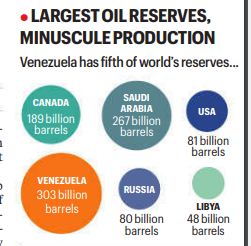
  • Oil Control: Venezuela holds the world’s largest proven oil reserves. President Trump has stated the U.S. will “run the country” temporarily to “get the oil flowing” and ensure a transition.
  • Regime Change: The U.S. has long sought to replace Maduro’s socialist government with a pro-Western administration, recently supporting figures like Nobel Peace Prize winner María Corina Machado and Edmundo González.
  • International Law: Many nations (including Russia and China) argue the abduction of a sitting head of state violates the UN Charter, while the U.S. maintains it is a “law enforcement function.”


Impact on the World:

  • Global Precedent: The use of military force to arrest a foreign leader sets a massive precedent in international relations, sparking fears of renewed “interventionism.”
  • Energy Markets: The prospect of U.S. oil companies rebuilding Venezuela’s crippled infrastructure could eventually lead to a shift in global oil prices.
  • Diplomatic Rift: The world is split; Russia called it an “act of armed aggression,” while some Latin American neighbors have welcomed the end of the Maduro era.

India & Venezuela Relations:

Impact on India
  • Travel Advisory: India has issued a high-level advisory (Jan 4, 2026) for its nationals to avoid all non-essential travel to Venezuela.
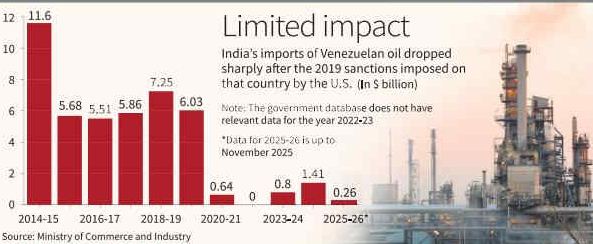
  • Energy Neutrality: While India was once a top buyer of Venezuelan oil, imports have been negligible recently due to past sanctions. Therefore, the immediate impact on India’s fuel supply is minimal.
  • Investments: Indian companies like ONGC Videsh (OVL), which has a 40% stake in the San Cristóbal oil field, now face a “wait-and-watch” situation regarding their assets.
  •  India imported $255.3 million worth of oil from Venezuela in the current financial year up to November 2025, about 0.3% of its total oil import during this period.
  • In 2013, India had imported as much as $13 billion worth of Venezuelan oil. Since 2019, India has been cutting its oil imports and commercial engagements with Venezuela in response to U.S. sanctions and threats of secondary sanctions.

OPEC member:

Venezuela is a member of the Organization of the Petroleum Exporting Countries (OPEC), a group of countries that largely dominates the global oil market. However, Venezuela currently produces a relatively small amount of crude oil compared with the other oil-producing nations.

According to OPEC data, Venezuela accounts for about 3.5% of the OPEC’s total oil exports, and about 1% of global oil supplies.

Heavy oil:

This relatively low supply is due to the U.S. sanctions on Venezuela and the heavy nature of Venezuelan oil, which requires special refineries that most countries do not have. Most of Venezuela’s oil supply goes to China.

Status of Relations:

  • Diplomatic Tightrope: India has expressed “deep concern” over the developments. True to its policy of “Strategic Autonomy,” India did not explicitly condemn the U.S. or support Maduro, instead calling for “dialogue and negotiation.”
  • Strong Ties with Successors: Interestingly, Venezuelan Vice President Delcy Rodríguez (who was recently sworn in as interim president by the Venezuelan Supreme Court) visited New Delhi in February 2025 for India Energy Week. This suggests India has maintained open channels with the various factions currently vying for power.

What the  UN Charter says?

The Prohibition of the Use of Force (UN Charter):

The most significant legal hurdle for the U.S. is Article 2(4) of the UN Charter, which mandates that all member states must refrain from the threat or use of force against the territorial integrity or political independence of any state.
  • The Violation: Legal scholars and the UN Secretary-General have noted that a unilateral military strike on a capital city to seize a leader is a direct breach of this article.
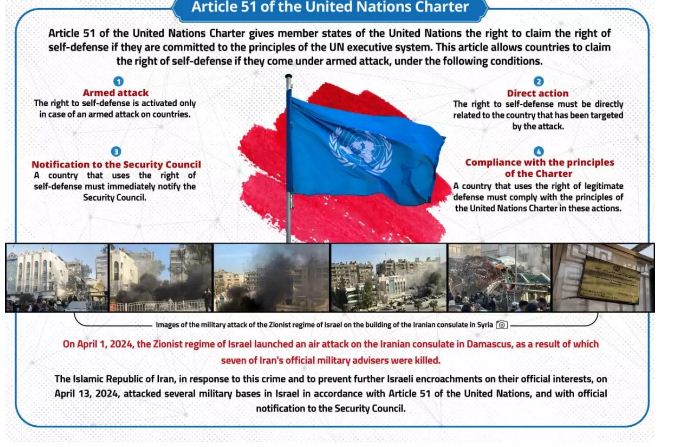
  • The U.S. Defense: The U.S. has invoked “Self-Defense” (Article 51), arguing that Maduro’s alleged “narco-terrorism” acts as a non-traditional weapon of mass destruction threatening American lives. However, traditional law requires an “actual armed attack” to trigger this right.

Sovereign Immunity of Heads of State:

Under Customary International Law, sitting heads of state enjoy “personal immunity” (ratione personae), which protects them from the criminal jurisdiction of foreign courts.

  • The Dispute: Generally, a sitting president cannot be arrested by another country.
  • The U.S. Loophole: The U.S. government (and many others) does not recognize Maduro as the legitimate president of Venezuela, following the disputed 2024 elections. U.S. courts typically follow the executive branch’s lead: if the White House says he isn’t the president, the court may rule he has no immunity.

The “Ker-Frisbie” Doctrine:

A unique feature of U.S. law is the Ker-Frisbie Doctrine. This rule states that U.S. courts can put a defendant on trial regardless of how they were brought to the country—even if they were kidnapped or forcibly abducted from a foreign nation.

  • This was the same legal basis used to try General Manuel Noriega of Panama in 1989 after a similar U.S. invasion.

Lack of International Mandate:

For a military intervention to be clearly legal under international law, it usually requires:

  • UN Security Council Authorization: (Which did not happen; Russia and China would have vetoed it).
  • Consent of the Host State: (The Venezuelan government has called the move an “act of aggression” and “kidnapping”).


Get In Touch

B-36, Sector-C Aliganj – Near Aliganj Post Office Lucknow – 226024 (U.P.) India

+91 8858209990, +91 9415011892

lucknowvaidsics@gmail.com / drpmtripathi.lucknow@gmail.com

UPSC INFO
Reach Us
Our Location

Google Play

About Us

VAIDS ICS Lucknow, a leading Consultancy for Civil Services & Judicial Services, was started in 1988 to provide expert guidance, consultancy, and counseling to aspirants for a career in Civil Services & Judicial Services.

The Civil Services (including the PCS) and the PCS (J) attract some of the best talented young persons in our country. The sheer diversity of work and it’s nature, the opportunity to serve the country and be directly involved in nation-building, makes the bureaucracy the envy of both-the serious and the adventurous. Its multi-tiered (Prelims, Mains & Interview) examination is one of the most stringent selection procedures. VAID’S ICS Lucknow, from its inception, has concentrated on the requirements of the civil services aspirants. The Institute expects, and helps in single-minded dedication and preparation.

© 2023, VAID ICS. All rights reserved. Designed by SoftFixer.com