• New Batch: 7 Sep , 2026

September 10, 2026

Daily Legal Current : 10 Sep Marital Rape Exception/Bharatiya Nyaya Sanhita (BNS), Section 63

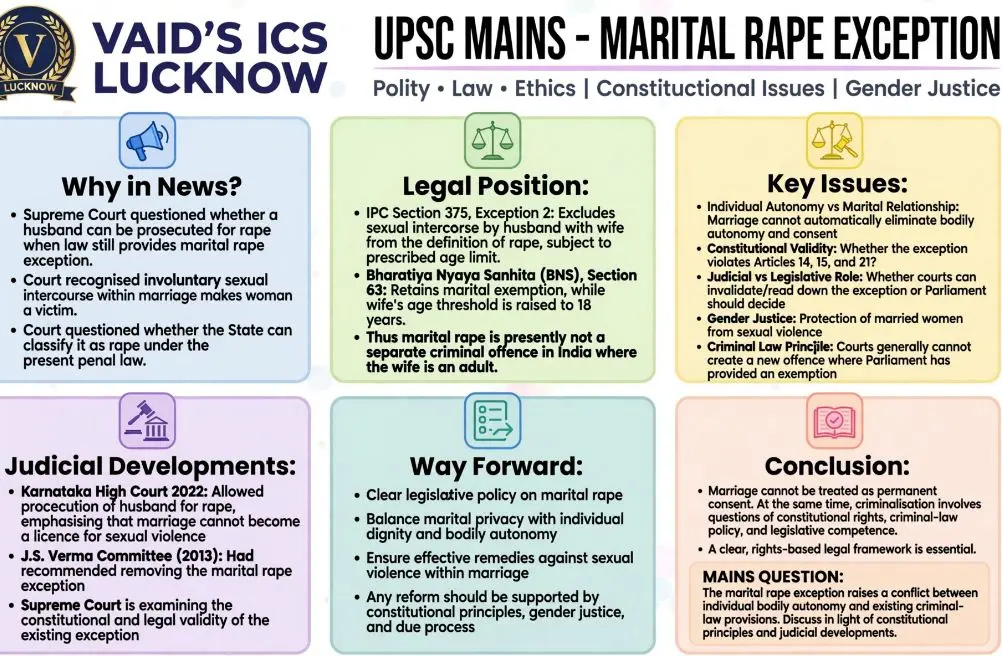
Why in News?

  • The Supreme Court questioned whether a husband can be prosecuted for rape when the law still provides a marital rape exception.

  • The Court recognised that involuntary sexual intercourse within marriage makes the woman a victim, but questioned whether the State can legally classify it as “rape” under the present penal law.

Legal Position:

  • Under IPC Section 375, Exception 2 excluded sexual intercourse by a husband with his wife from the definition of rape, subject to the prescribed age limit.

  • Bharatiya Nyaya Sanhita (BNS), Section 63 retains this marital exemption, while the wife’s age threshold has been raised to 18 years.

  • Thus, marital rape is presently not a separate criminal offence in India where the wife is an adult.

Key Issues:

  • Individual autonomy vs marital relationship: Marriage cannot automatically eliminate bodily autonomy and consent.

  • Constitutional validity: Whether the exception violates Articles 14, 15 and 21.

  • Judicial vs legislative role: Whether courts can invalidate/read down the exception or Parliament should decide.

  • Gender justice: Protection of married women from sexual violence.

  • Criminal law principle: Courts generally cannot create a new offence where Parliament has expressly provided an exemption.

Judicial Developments:

  • Karnataka High Court, 2022: Allowed prosecution of a husband for rape, emphasising that marriage cannot become a licence for sexual violence.

  • The J.S. Verma Committee (2013) had recommended removing the marital rape exception.

  • The Supreme Court is examining the constitutional and legal validity of the existing exception.

Way Forward:

  • Clear legislative policy on marital rape.

  • Balance marital privacy with individual dignity and bodily autonomy.

  • Ensure effective remedies against sexual violence within marriage.

  • Any reform should be supported by constitutional principles, gender justice and due process.

Conclusion:

Marriage cannot be treated as permanent consent. At the same time, criminalisation of marital rape involves significant questions of constitutional rights, criminal-law policy and legislative competence. A clear and rights-based legal framework is therefore essential.

 Mains Question:

“The marital rape exception raises a conflict between individual bodily autonomy and existing criminal-law provisions. Discuss in the light of constitutional principles and judicial developments.”

वैवाहिक बलात्कार अपवाद:

Why in News?

  • सर्वोच्च न्यायालय ने वैवाहिक बलात्कार के मामलों में पति के विरुद्ध बलात्कार के अभियोजन से संबंधित प्रश्न पर विचार किया।

  • न्यायालय ने माना कि विवाह के भीतर बिना सहमति के यौन संबंध बनाने वाली महिला पीड़िता है, लेकिन वर्तमान दंड कानून में इसे प्रत्येक स्थिति में “बलात्कार” के रूप में परिभाषित नहीं किया गया है।

विधिक स्थिति:

  • भारतीय दंड संहिता, 1860 की धारा 375, अपवाद 2 के तहत पत्नी के साथ पति द्वारा यौन संबंध को बलात्कार की परिभाषा से बाहर रखा गया था, बशर्ते पत्नी निर्धारित आयु से कम न हो।

  • भारतीय न्याय संहिता, 2023 की धारा 63 ने इस वैवाहिक अपवाद को बनाए रखा है, हालांकि पत्नी की आयु सीमा 18 वर्ष कर दी गई है।

  • वर्तमान कानून के अनुसार, वयस्क पत्नी के साथ वैवाहिक बलात्कार अलग से दंडनीय बलात्कार अपराध नहीं है।

प्रमुख मुद्दे:

  • व्यक्तिगत स्वायत्तता बनाम वैवाहिक संबंध: क्या विवाह महिला की शारीरिक स्वायत्तता और सहमति के अधिकार को समाप्त कर देता है?

  • संवैधानिक वैधता: क्या वैवाहिक बलात्कार अपवाद अनुच्छेद 14, 15 और 21 के अनुरूप है?

  • न्यायपालिका बनाम विधायिका: क्या न्यायालय कानून की व्याख्या कर अपवाद को समाप्त या सीमित कर सकता है, या यह संसद का विषय है?

  • महिला गरिमा एवं लैंगिक न्याय: विवाह के भीतर यौन हिंसा से महिलाओं की प्रभावी सुरक्षा।

  • दंड कानून का सिद्धांत: स्पष्ट विधायी अपवाद की स्थिति में न्यायालय द्वारा नया अपराध निर्मित करने की सीमा।

न्यायिक विकास:

  • कर्नाटक उच्च न्यायालय, 2022: पति के विरुद्ध बलात्कार के आरोप में अभियोजन की अनुमति दी और कहा कि विवाह यौन हिंसा का लाइसेंस नहीं हो सकता।

  • न्यायमूर्ति जे.एस. वर्मा समिति, 2013: वैवाहिक बलात्कार अपवाद को हटाने की सिफारिश की थी।

  • सर्वोच्च न्यायालय: अब इस अपवाद की संवैधानिक वैधता और विधिक स्थिति पर विचार कर रहा है।

आगे की राह:

  • वैवाहिक यौन हिंसा पर स्पष्ट विधायी नीति आवश्यक।

  • शारीरिक स्वायत्तता, गरिमा और वैवाहिक संस्था के बीच संतुलन।

  • पीड़ित महिलाओं के लिए प्रभावी कानूनी उपचार।

  • सुधार संवैधानिक मूल्यों, लैंगिक न्याय और विधि के शासन पर आधारित होना चाहिए।

निष्कर्ष:

विवाह को स्थायी सहमति का आधार नहीं माना जा सकता। साथ ही, वैवाहिक बलात्कार को अपराध घोषित करने का प्रश्न संवैधानिक अधिकारों, दंड विधि और विधायी नीति से जुड़ा है। अतः अधिकार-आधारित और स्पष्ट विधायी व्यवस्था आवश्यक है।

 मुख्य परीक्षा प्रश्न:

“वैवाहिक बलात्कार अपवाद व्यक्तिगत शारीरिक स्वायत्तता और वर्तमान दंड विधि के बीच संघर्ष को दर्शाता है। संवैधानिक सिद्धांतों एवं न्यायिक विकास के संदर्भ में चर्चा कीजिए।”


Get In Touch

B-36, Sector-C Aliganj – Near Aliganj Post Office Lucknow – 226024 (U.P.) India

+91 8858209990, +91 9415011892

lucknowvaidsics@gmail.com / drpmtripathi.lucknow@gmail.com

UPSC INFO
Reach Us
Our Location

Google Play

About Us

VAIDS ICS Lucknow, a leading Consultancy for Civil Services & Judicial Services, was started in 1988 to provide expert guidance, consultancy, and counseling to aspirants for a career in Civil Services & Judicial Services.

The Civil Services (including the PCS) and the PCS (J) attract some of the best talented young persons in our country. The sheer diversity of work and it’s nature, the opportunity to serve the country and be directly involved in nation-building, makes the bureaucracy the envy of both-the serious and the adventurous. Its multi-tiered (Prelims, Mains & Interview) examination is one of the most stringent selection procedures. VAID’S ICS Lucknow, from its inception, has concentrated on the requirements of the civil services aspirants. The Institute expects, and helps in single-minded dedication and preparation.

© 2023, VAID ICS. All rights reserved. Designed by SoftFixer.com