September 14, 2026
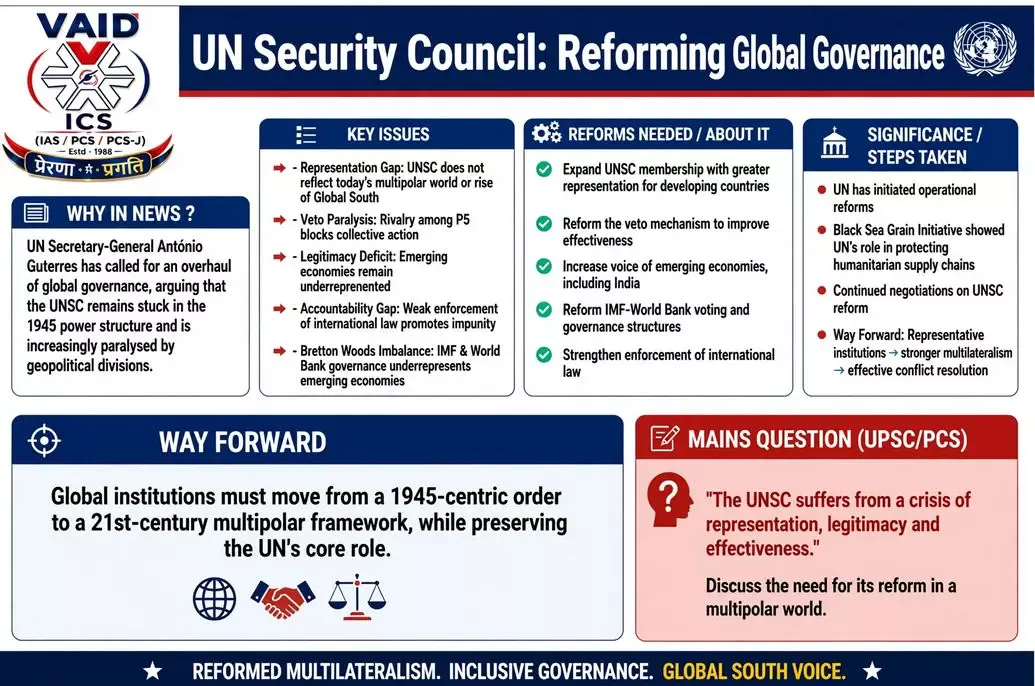
United Nations Secretary-General Antonio Guterres, in an interview with The Hindu on the sidelines of the BRICS Summit, strongly criticised the growing culture of “impunity” and geopolitical division that has paralysed the UN Security Council.
He argued that the existing global governance system still reflects the power realities of 1945, rather than the emerging multipolar world.
1. Limits of Superpower Power:
Major powers have not adequately recognised that their power has limits.
Their unilateral actions and geopolitical rivalries have produced serious humanitarian and security consequences.
The growing geopolitical divide has weakened collective decision-making.
2. UN and Prevention of World War:
According to Guterres, the UN has contributed to preventing a third World War since its creation after World War II.
Although conflicts continue across the world, the absence of direct war between major superpowers is significant.
3. Paralysis of the UN Security Council:
The Security Council has become increasingly non-operational because of divisions among powerful states.
This creates two major problems:
Legitimacy deficit: The Council does not adequately represent today’s world.
Effectiveness deficit: Geopolitical divisions prevent timely collective action.
The present structure largely reflects the international power balance of 1945.
Major concerns:
Emerging economies remain underrepresented.
The distribution of decision-making power does not reflect contemporary global realities.
Veto-based politics can prevent collective action.
Lack of consensus weakens the UN’s ability to respond to conflicts and violations of international law.
Guterres’s position: The requirement is not merely a limited reform, but an “overhaul” of global governance and power relations.
Guterres also criticised the mismatch between the Bretton Woods system and today’s economic realities.
Emerging economies are underrepresented in institutions such as:
World Bank
International Monetary Fund (IMF)
Reform should therefore extend beyond the Security Council to the broader architecture of global economic governance.
Guterres emphasised that freedom of navigation is fundamental.
The UN has sought mechanisms to ensure that blockades do not prevent the movement of essential commodities such as:
Food
Fertilisers
He referred to the Black Sea Grain Initiative as an example of efforts to protect essential supplies during conflict.
Guterres appreciated India’s diplomatic engagement in conflicts involving:
Russia–Ukraine
Gulf region
He highlighted India’s role as a potential:
“Mediator + Messenger of Peace + Bridge Builder”
India’s relationships with different geopolitical camps can provide it with diplomatic space to facilitate trust-building and dialogue.
Guterres stated that the UN is not directly involved in a mediation process between India and Pakistan.
Mediation requires the agreement of both parties.
He expressed hope that India and Pakistan could eventually come together.
Guterres maintained that:
The UN’s position is based on the UN Charter, international law and humanitarian law.
The situation in Gaza represents a serious violation of international-law principles.
However, whether an act legally constitutes genocide is a determination for competent judicial institutions.
Important distinction for UPSC:
Political condemnation ≠ legal determination of genocide.
One of the most important concerns raised was the absence of an effective mechanism to ensure that violations of international law are consistently punished.
This produces a situation where powerful states may believe that they can act without meaningful consequences.
Guterres rejected the argument that the UN itself has collapsed.
Despite resource constraints:
UN humanitarian agencies continue functioning.
They provide assistance in some of the world’s most dangerous regions.
The organisation retains institutional capacity for reform.
Therefore, the deeper problem is not the existence of the UN, but the distribution of power within the international system.
The central crisis of the UN is a crisis of power.
The world has changed substantially since 1945, but the institutional architecture of global governance has not changed proportionately.
1945 power structure → Present multipolar reality → Representation gap → Legitimacy deficit → Decision-making paralysis
Reform the UN Security Council to reflect contemporary geopolitical realities.
Improve representation of emerging and developing economies.
Reform the broader Bretton Woods institutions.
Strengthen mechanisms for compliance with international law.
Protect freedom of navigation and humanitarian supply chains.
Encourage credible mediation and dialogue.
Strengthen multilateral institutions rather than replacing them.
Make global governance more representative, legitimate and effective.
The issue reflects the broader tension between multipolarity and outdated multilateral institutions.
A reformed global order must balance:
Sovereignty + Representation + Accountability + Effective Multilateralism
The challenge before the UN is not simply institutional survival but institutional adaptation. A global governance system designed around the realities of 1945 cannot effectively manage a multipolar world of the 21st century; hence, meaningful reform of the Security Council and wider global institutions is essential for restoring legitimacy, effectiveness and faith in multilateralism.
संयुक्त राष्ट्र महासचिव एंटोनियो गुटेरेस ने द हिन्दू को दिए एक साक्षात्कार में “दण्डमुक्ति (Impunity)” की संस्कृति और बढ़ते भू-राजनीतिक विभाजन पर गंभीर चिंता व्यक्त की, जिसके कारण संयुक्त राष्ट्र सुरक्षा परिषद (UNSC) प्रभावी निर्णय लेने में असमर्थ हो रही है।
उन्होंने कहा कि वर्तमान वैश्विक शासन व्यवस्था मुख्यतः 1945 की शक्ति-संरचना को प्रतिबिंबित करती है, जबकि आज विश्व की राजनीतिक एवं आर्थिक वास्तविकताएँ काफी बदल चुकी हैं।
1. महाशक्तियों की शक्ति की सीमाएँ:
प्रमुख शक्तियों ने अभी तक यह पर्याप्त रूप से स्वीकार नहीं किया है कि उनकी शक्ति भी सीमित है।
एकतरफा कार्रवाइयों और भू-राजनीतिक प्रतिद्वंद्विता के कारण गंभीर मानवीय एवं सुरक्षा संकट उत्पन्न हुए हैं।
बढ़ते भू-राजनीतिक विभाजन ने सामूहिक निर्णय-प्रक्रिया को कमजोर किया है।
2. संयुक्त राष्ट्र और तृतीय विश्व युद्ध की रोकथाम:
गुटेरेस के अनुसार, द्वितीय विश्व युद्ध के बाद संयुक्त राष्ट्र ने अब तक तीसरे विश्व युद्ध को रोकने में महत्वपूर्ण भूमिका निभाई है।
यद्यपि विश्व के विभिन्न क्षेत्रों में अनेक संघर्ष जारी हैं, फिर भी दो महाशक्तियों के बीच प्रत्यक्ष युद्ध का न होना महत्वपूर्ण है।
3. सुरक्षा परिषद का गतिरोध:
शक्तिशाली देशों के बीच बढ़ते मतभेदों के कारण सुरक्षा परिषद प्रभावी रूप से कार्य करने में असमर्थ हो रही है।
इससे दो प्रमुख समस्याएँ उत्पन्न होती हैं:
वैधता का संकट: परिषद आज की विश्व-व्यवस्था का पर्याप्त प्रतिनिधित्व नहीं करती।
प्रभावशीलता का संकट: भू-राजनीतिक मतभेद सामूहिक कार्रवाई को बाधित करते हैं।
वर्तमान सुरक्षा परिषद मुख्यतः 1945 के वैश्विक शक्ति-संतुलन को प्रतिबिंबित करती है।
प्रमुख समस्याएँ:
उभरती अर्थव्यवस्थाओं और विकासशील देशों का अपर्याप्त प्रतिनिधित्व।
निर्णय लेने की शक्ति का वर्तमान वैश्विक शक्ति-संतुलन के अनुरूप न होना।
वीटो व्यवस्था के कारण सामूहिक कार्रवाई में बाधा।
प्रमुख शक्तियों के मतभेदों के कारण संघर्षों पर समयबद्ध कार्रवाई कठिन होना।
गुटेरेस का दृष्टिकोण: केवल सीमित सुधार पर्याप्त नहीं है; वैश्विक शासन एवं शक्ति-संबंधों का व्यापक पुनर्गठन (Overhaul) आवश्यक है।
गुटेरेस ने ब्रेटन वुड्स व्यवस्था में भी प्रतिनिधित्व के असंतुलन पर चिंता व्यक्त की।
उभरती अर्थव्यवस्थाओं का पर्याप्त प्रतिनिधित्व नहीं है।
विशेष रूप से:
विश्व बैंक
अंतर्राष्ट्रीय मुद्रा कोष (IMF)
इसलिए वैश्विक आर्थिक शासन को भी वर्तमान आर्थिक वास्तविकताओं के अनुरूप बनाया जाना आवश्यक है।
गुटेरेस ने नौवहन की स्वतंत्रता (Freedom of Navigation) को मूलभूत सिद्धांत बताया।
संयुक्त राष्ट्र ने संघर्ष की स्थिति में आवश्यक वस्तुओं की आपूर्ति बनाए रखने के लिए ऐसे तंत्रों का समर्थन किया है, जिनसे अवरोध के बावजूद:
खाद्य पदार्थ
उर्वरक
जैसी आवश्यक वस्तुओं का परिवहन जारी रह सके।
उन्होंने काला सागर अनाज पहल (Black Sea Grain Initiative) को इसका उदाहरण बताया।
गुटेरेस ने रूस-यूक्रेन संघर्ष तथा खाड़ी क्षेत्र में भारत के कूटनीतिक प्रयासों की सराहना की।
उन्होंने भारत को संभावित:
“मध्यस्थ + शांति-दूत + सेतु-निर्माता”
के रूप में महत्वपूर्ण माना।
भारत के विभिन्न शक्ति-गुटों के साथ संबंध उसे विश्वास निर्माण, संवाद और मध्यस्थता में विशेष भूमिका प्रदान कर सकते हैं।
गुटेरेस के अनुसार, संयुक्त राष्ट्र भारत और पाकिस्तान के बीच किसी प्रत्यक्ष मध्यस्थता प्रक्रिया में शामिल नहीं है।
मध्यस्थता के लिए दोनों पक्षों की सहमति आवश्यक है।
उन्होंने दोनों देशों के भविष्य में साथ आने की आशा व्यक्त की।
गुटेरेस ने स्पष्ट किया कि:
संयुक्त राष्ट्र की स्थिति संयुक्त राष्ट्र चार्टर, अंतर्राष्ट्रीय विधि तथा अंतर्राष्ट्रीय मानवीय विधि पर आधारित है।
गाजा में हो रही घटनाएँ अंतर्राष्ट्रीय विधि के सिद्धांतों का गंभीर उल्लंघन हैं।
हालांकि किसी घटना को कानूनी रूप से “नरसंहार (Genocide)” घोषित करना सक्षम न्यायिक संस्थाओं का विषय है।
UPSC के लिए महत्वपूर्ण अंतर:
राजनीतिक निंदा ≠ नरसंहार का कानूनी निर्धारण
गुटेरेस की प्रमुख चिंताओं में से एक यह है कि अंतर्राष्ट्रीय विधि के उल्लंघनों के लिए प्रभावी एवं समान रूप से लागू होने वाली दंडात्मक व्यवस्था का अभाव है।
इसके कारण शक्तिशाली देशों को यह धारणा हो सकती है कि वे गंभीर उल्लंघनों के बावजूद प्रभावी परिणामों से बच सकते हैं।
गुटेरेस ने इस धारणा को अस्वीकार किया कि संयुक्त राष्ट्र स्वयं विफल हो चुका है।
संसाधनों की कमी के बावजूद:
संयुक्त राष्ट्र की मानवीय संस्थाएँ कार्यरत हैं।
वे विश्व के अत्यंत संकटग्रस्त क्षेत्रों में सहायता प्रदान कर रही हैं।
संगठन में अपनी कार्यप्रणाली एवं संस्थागत संरचनाओं में सुधार करने की क्षमता मौजूद है।
इसलिए मूल समस्या संयुक्त राष्ट्र के अस्तित्व की नहीं, बल्कि अंतर्राष्ट्रीय व्यवस्था में शक्ति के असमान वितरण की है।
गुटेरेस के अनुसार, संयुक्त राष्ट्र का केंद्रीय संकट “शक्ति का संकट” है।
विश्व 1945 से बहुत आगे बढ़ चुका है, लेकिन वैश्विक शासन की संस्थागत संरचना उसी अनुपात में परिवर्तित नहीं हुई है।
1945 की शक्ति-संरचना → वर्तमान बहुध्रुवीय विश्व → प्रतिनिधित्व का अंतर → वैधता का संकट → निर्णय-प्रक्रिया में गतिरोध
संयुक्त राष्ट्र सुरक्षा परिषद में व्यापक सुधार।
उभरती एवं विकासशील अर्थव्यवस्थाओं का बेहतर प्रतिनिधित्व।
ब्रेटन वुड्स संस्थाओं में प्रतिनिधित्व सुधार।
अंतर्राष्ट्रीय विधि के अनुपालन हेतु प्रभावी तंत्र।
नौवहन की स्वतंत्रता एवं मानवीय आपूर्ति मार्गों की सुरक्षा।
विश्वसनीय मध्यस्थता एवं संवाद को बढ़ावा।
बहुपक्षीय संस्थाओं को मजबूत करना।
वैश्विक शासन को अधिक प्रतिनिधित्वपूर्ण, वैध और प्रभावी बनाना।
यह मुद्दा बहुध्रुवीयता और पुरानी बहुपक्षीय संस्थाओं के बीच बढ़ते तनाव को दर्शाता है।
भविष्य की वैश्विक शासन व्यवस्था में संतुलन आवश्यक है:
संप्रभुता + प्रतिनिधित्व + जवाबदेही + प्रभावी बहुपक्षवाद
संयुक्त राष्ट्र के सामने चुनौती केवल उसके अस्तित्व को बनाए रखने की नहीं, बल्कि बदलती वैश्विक शक्ति-संरचना के अनुरूप स्वयं को पुनर्गठित करने की है। 1945 की परिस्थितियों में निर्मित वैश्विक शासन व्यवस्था आज की बहुध्रुवीय दुनिया की जटिलताओं का प्रभावी ढंग से सामना नहीं कर सकती; अतः सुरक्षा परिषद और व्यापक वैश्विक शासन संस्थाओं में सार्थक सुधार आवश्यक हैं ताकि बहुपक्षवाद की वैधता, प्रभावशीलता और विश्वसनीयता पुनर्स्थापित की जा सके।
B-36, Sector-C Aliganj – Near Aliganj Post Office Lucknow – 226024 (U.P.) India
+91 8858209990, +91 9415011892
lucknowvaidsics@gmail.com / drpmtripathi.lucknow@gmail.com
About Us
VAIDS ICS Lucknow, a leading Consultancy for Civil Services & Judicial Services, was started in 1988 to provide expert guidance, consultancy, and counseling to aspirants for a career in Civil Services & Judicial Services.
The Civil Services (including the PCS) and the PCS (J) attract some of the best talented young persons in our country. The sheer diversity of work and it’s nature, the opportunity to serve the country and be directly involved in nation-building, makes the bureaucracy the envy of both-the serious and the adventurous. Its multi-tiered (Prelims, Mains & Interview) examination is one of the most stringent selection procedures. VAID’S ICS Lucknow, from its inception, has concentrated on the requirements of the civil services aspirants. The Institute expects, and helps in single-minded dedication and preparation.
© 2023, VAID ICS. All rights reserved. Designed by SoftFixer.com