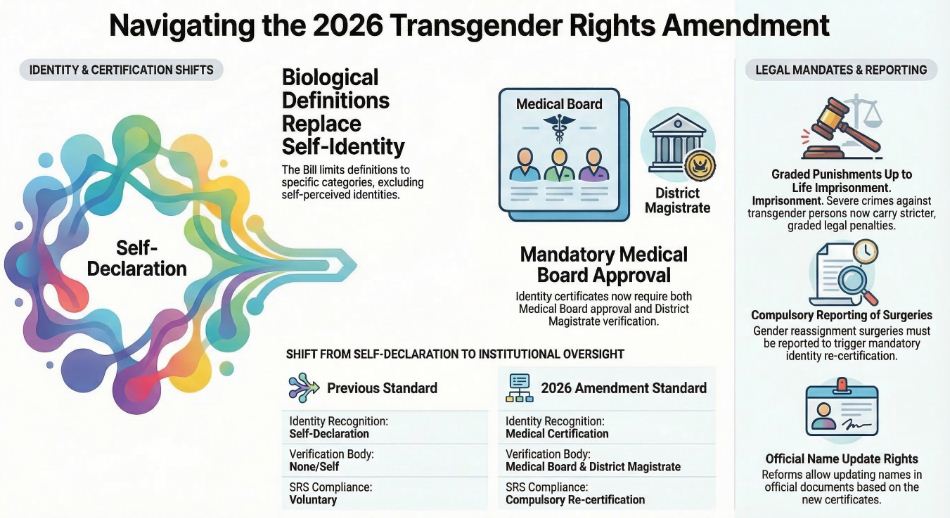
The Transgender Persons (Protection of Rights) Amendment Bill, 2026 was introduced in the Lok Sabha on March 13, 2026, by the Minister of Social Justice and Empowerment. It represents a significant shift in India’s legal approach to gender identity, moving from the 2019 Act’s “self-identification” model back toward a more medicalized and biological framework.

Key Issues & Changes:
The primary conflict lies in the government’s attempt to “narrow” the definition of who qualifies as a transgender person to ensure benefits reach “genuine” beneficiaries.
- End of Self-Identification: The Bill removes the right to “self-perceived gender identity,” which was the core of previous legal protections.
- Narrowed Definition: It replaces a broad definition with a specific list:
-
- Socio-cultural identities (Kinner, Hijra, Aravani, Jogta, Eunuch).
- Persons with intersex variations or congenital biological variations.
- Exclusion: It explicitly excludes those with “self-perceived sexual identities” or different sexual orientations.
- Medical Gatekeeping: Instead of a simple administrative application, identity must now be verified by a Medical Board (headed by a Chief Medical Officer) before a District Magistrate issues a certificate.
Legal & Constitutional Provisions:
Critics argue the Bill may be unconstitutional as it clashes with several fundamental rights:
- Article 14 (Equality): By creating a distinction between “biological/cultural” trans persons and those who self-identify, it is accused of arbitrary classification.
- Article 19 (Freedom of Expression): Gender expression is considered a part of free speech; mandatory medical checks may infringe on this.
- Article 21 (Right to Life & Dignity): This includes the right to autonomy and privacy. The Bill’s medicalized approach is seen as an intrusion into personal dignity.
Landmark Case Law:
The Bill is widely viewed as a “regressive turn” that contradicts over a decade of Supreme Court jurisprudence:
- NALSA v. Union of India (2014): The foundational judgment that recognized the “Third Gender” and affirmed that self-determination of gender is a fundamental right.
- Puttaswamy v. Union of India (2017): Established the Right to Privacy, noting that gender identity is at the very core of individual autonomy.
- Navtej Singh Johar v. Union of India (2018): Reinforced that “constitutional morality” must protect the rights of sexual and gender minorities against social prejudice.
Way Forward & Conclusion:
The Bill is currently a subject of intense national debate, particularly within the LGBTQ+ community and legal circles.
- Strengthened Penalties: On a positive note, the Bill introduces much harsher punishments (up to life imprisonment) for serious crimes like forced mutilation, kidnapping, or forced begging involving transgender persons.
- Policy Direction: Experts suggest the government should reconsider the “Medical Board” requirement and return to a self-declaration model to align with the NALSA judgment.
- Conclusion: While the Bill aims to prevent the misuse of benefits and curb crimes like forced castration, its “biological-only” focus risks excluding and “invisibilizing” trans-men, trans-women, and non-binary individuals who do not fit into traditional socio-cultural groups.
Article based Mains Qn : UPSC/PCS-250/200 words
“The Transgender Persons (Protection of Rights) Amendment Bill, 2026, marks a shift from ‘self-identification’ to ‘medical gatekeeping.’ Critically analyze
उभयलिंगी व्यक्ति (अधिकारों का संरक्षण) संशोधन विधेयक, 2026:
यह विधेयक 13 मार्च, 2026 को सामाजिक न्याय और अधिकारिता मंत्री द्वारा लोकसभा में पेश किया गया था। इसका मुख्य उद्देश्य 2019 के अधिनियम में बदलाव कर “पहचान” के आधार को जैविक और सांस्कृतिक मानदंडों तक सीमित करना है।
प्रमुख प्रावधान:
- “उभयलिंगी व्यक्ति” (Transgender Person) की नई परिभाषा: विधेयक ने 2019 अधिनियम की व्यापक परिभाषा को हटाकर इसे जैविक सूची तक सीमित कर दिया है।
- शामिल श्रेणियाँ: इसमें केवल विशिष्ट सामाजिक-सांस्कृतिक पहचान वाले व्यक्तियों (किन्नर, हिजड़ा, अरावनी, जोगता, खोजा) और जन्मजात जैविक भिन्नता (Intersex variations) वाले लोगों को ही शामिल किया गया है।
- अपवर्जन (Exclusions): यह स्पष्ट करता है कि “स्व-अनुभूत यौन पहचान” (self-perceived identity) या केवल अलग यौन रुझान रखने वाले व्यक्ति इस श्रेणी में नहीं आएंगे।
- पदों को हटाना: परिभाषा से “ट्रांस-मेन”, “ट्रांस-वुमेन” और “जेंडरक्वीर” जैसे शब्दों को हटा दिया गया है।
- चिकित्सा द्वाररक्षण (Medical Gatekeeping): अब पहचान का प्रमाण पत्र केवल स्व-घोषणा के आधार पर नहीं मिलेगा।
- चिकित्सा बोर्ड की जांच: पहचान प्रमाण पत्र के लिए अब एक चिकित्सा बोर्ड की सिफारिश अनिवार्य होगी।
- बोर्ड का गठन: इस बोर्ड का नेतृत्व मुख्य चिकित्सा अधिकारी (CMO) या उप CMO करेंगे।
- जिला मजिस्ट्रेट (DM) की भूमिका: DM केवल चिकित्सा बोर्ड की रिपोर्ट के आधार पर ही प्रमाण पत्र जारी करेगा।
- सख्त दंड और श्रेणीबद्ध सजा: उभयलिंगी व्यक्तियों के विरुद्ध अपराधों के लिए दंड को काफी कड़ा कर दिया गया है:
- आजीवन कारावास: किसी बच्चे को उभयलिंगी पहचान के लिए मजबूर करने हेतु उसका अपहरण, अंग-भंग या जबरन बधियाकरण करने पर।
- 10 वर्ष से आजीवन कारावास: वयस्कों के विरुद्ध ऐसे ही अपराधों के लिए।
- भिक्षावृत्ति और जबरन श्रम: किसी को जबरन उभयलिंगी दिखाकर भीख मंगवाने या बंधुआ मजदूरी कराने पर 5 से 14 वर्ष तक की सजा।
- अनिवार्य रिपोर्टिंग और पुन: प्रमाणन:
- SRS की रिपोर्टिंग: लिंग परिवर्तन सर्जरी (SRS) करने वाले अस्पतालों को इसकी सूचना DM और निर्दिष्ट अधिकारियों को देना अनिवार्य होगा।
- अनिवार्य पुन: प्रमाणन: सर्जरी के बाद नया प्रमाण पत्र लेना अब वैकल्पिक नहीं बल्कि अनिवार्य होगा।
मुख्य मुद्दे और चुनौतियाँ:
- स्व-पहचान का अंत: यह विधेयक “स्व-अनुभूत लिंग पहचान” के अधिकार को समाप्त करता है, जो पिछले कानूनी संरक्षणों का आधार था।
- संवैधानिक प्रावधानों का उल्लंघन:
अनुच्छेद 14 (समानता): जैविक और स्व-पहचान वाले व्यक्तियों के बीच भेदभाव के कारण इसे ‘मनमाना वर्गीकरण’ कहा जा रहा है।
अनुच्छेद 19 (अभिव्यक्ति की स्वतंत्रता): पहनावा और व्यवहार अभिव्यक्ति का हिस्सा हैं, जिस पर चिकित्सा जांच का दबाव पड़ेगा।
अनुच्छेद 21 (जीवन और गरिमा): निजता और अपने व्यक्तित्व को चुनने का अधिकार इस विधेयक से प्रभावित हो सकता है।
महत्वपूर्ण न्यायिक निर्णय (Case Laws):
यह विधेयक सर्वोच्च न्यायालय के पिछले निर्णयों के विपरीत माना जा रहा है:
- नालसा बनाम भारत संघ (2014): जिसमें “तीसरे लिंग” को मान्यता दी गई और स्व-पहचान को मौलिक अधिकार माना गया।
- पुट्टस्वामी बनाम भारत संघ (2017): जिसने ‘निजता के अधिकार’ को मौलिक अधिकार घोषित किया और लिंग पहचान को इसका अभिन्न हिस्सा माना।
- नवतेज सिंह जौहर बनाम भारत संघ (2018): जिसने संवैधानिक नैतिकता के आधार पर लैंगिक अल्पसंख्यकों के अधिकारों की रक्षा की बात कही।
निष्कर्ष एवं आगे की राह:
विधेयक का सकारात्मक पक्ष इसके कड़े दंड प्रावधान हैं, जो जबरन अंग-भंग और शोषण को रोकेंगे। हालांकि, विशेषज्ञों का मानना है कि सरकार को ‘चिकित्सा बोर्ड’ की अनिवार्यता पर पुनर्विचार करना चाहिए ताकि यह नालसा निर्णय के अनुरूप हो सके। केवल “जैविक” आधार पर ध्यान देने से वे ट्रांस-मेन और ट्रांस-वुमेन हाशिये पर जा सकते हैं जो पारंपरिक सांस्कृतिक समूहों का हिस्सा नहीं हैं।
आर्टिकल पर आधारित मेन्स प्रश्न: यूपीएससी/पीसीएस-250/200 शब्द:
उभयलिंगी व्यक्ति (अधिकारों का संरक्षण) संशोधन विधेयक, 2026, ‘स्व-पहचान’ (Self-identification) से ‘चिकित्सा द्वाररक्षण’ (Medical gatekeeping) की ओर एक बदलाव का संकेत देता है। विश्लेषण कीजिए।
|