May 19, 2026
RTI Act, and the Concept of “Public Authority”
Why in news? The Central Information Commission (CIC) ruled that the Board of Control for Cricket in India (BCCI) falls outside the ambit of Section 2(h) of the RTI Act
What is a “Public Authority” under the RTI Act, 2005?
Under Section 2(h) of the Right to Information (RTI) Act, 2005, a “public authority” refers to any authority, body, or institution of self-government established or constituted:
- By or under the Constitution (e.g., Election Commission, UPSC).
- By any other law made by Parliament (e.g., National Human Rights Commission).
- By any other law made by State Legislature (e.g., State Information Commissions).
- By a notification issued or order made by the appropriate Government.
It also explicitly includes:
- Any body owned, controlled, or substantially financed directly or indirectly by funds provided by the appropriate Government.
- Non-Government Organizations (NGOs) substantially financed, directly or indirectly, by funds provided by the appropriate Government.
Why is BCCI NOT a “Public Authority”? (The CIC Ruling)
The Central Information Commission (CIC) ruled that the Board of Control for Cricket in India (BCCI) falls outside the ambit of Section 2(h) of the RTI Act based on the following criteria:
- Nature of Establishment: The BCCI was neither established by the Constitution nor created through a specific statutory law passed by Parliament or a state legislature. It is a private, autonomous body registered under the Tamil Nadu Societies Registration Act.
- Financial Autonomy: The board is not substantially financed by the government. It functions as a self-sustaining corporate entity, generating its massive revenue independently through media rights, broadcasting deals, ticket sales, and corporate sponsorships.
- Lack of Control: The government does not exercise “deep or pervasive control” over the day-to-day administration, election of office bearers, or operational decisions of the BCCI.
Historical Context / Jurisdictional Shift: This ruling concludes a long-standing dispute. In 2018, a previous CIC order had declared the BCCI a public authority (aligned with Law Commission recommendations). However, the latest ruling reverses that stance by strictly adhering to the literal legal parameters of Section 2(h).
Arguments FOR Bringing BCCI under the RTI Act
While the CIC has given a strict legal interpretation, sports reform advocates and legal experts have historically argued that the BCCI should be accountable under RTI due to the following factors:
- De Facto Monopoly & State Functions: The BCCI enjoys a state-sanctioned monopoly over cricket in India. It selects the official national team, uses the national flag, and represents the Sovereign Democratic Republic of India on international platforms (ICC).
- Indirect Government Subsidies: Though not directly funded, the BCCI has historically benefited from massive indirect state support, including:
- Highly subsidized land allocations for cricket stadiums by state governments.
- Tax exemptions under charitable trust provisions (historically).
- Massive state expenditure on security and logistics during matches.
- Public Interest & Public Function: Cricket in India is not merely a sport; it involves immense public interest, public sentiment, and thousands of crores of rupees. The Supreme Court-appointed Lodha Committee previously recommended that the BCCI be brought under the RTI to ensure financial transparency and curb corruption.
Arguments AGAINST (In Alignment with the Current Ruling)
- Threat to Autonomy: Applying the RTI Act could lead to administrative overreach, political interference, and frivolous litigation, hampering the agility of a globally successful sports body.
- Precedent for Other Sports Bodies: If a purely self-funded body is forced under RTI, it opens a Pandora’s box for all private sports academies, clubs, and federations operating under societies registration.
- Strict Statutory Interpretation: In administrative law, unless an entity satisfies the objective checklists of Section 2(h) (ownership, control, or direct substantial funding), it cannot be judicially or quasi-judicially coerced into becoming a public authority.
Way Forward :
The debate highlights a classic tussle between the strict letter of the law and the spirit of public accountability. While the BCCI technically satisfies the definition of a private club from a financial and statutory viewpoint, its functional reality is deeply intertwined with the public sphere.
To bridge this gap without diluting the autonomy of private sports bodies, Parliament could consider introducing a tailored Sports Fraud and Transparency Legislation that mandates fiscal disclosure and grievance redressal for all national sports federations, without blanketly enforcing the administrative machinery of the RTI Act.
About Right to Information (RTI) Act, 2005:
Introduction and Constitutional Basis:
The Right to Information (RTI) Act, 2005 was enacted to secure access to information under the control of public authorities for citizens.
- Constitutional Ambit: While not explicitly mentioned in the Constitution, the Supreme Court (State of UP v. Raj Narain, 1975) ruled that the RTI is an implied fundamental right flowing from Article 19(1)(a) (Freedom of Speech and Expression) and Article 21 (Right to Life and Liberty).
Core Objectives of the RTI Act:
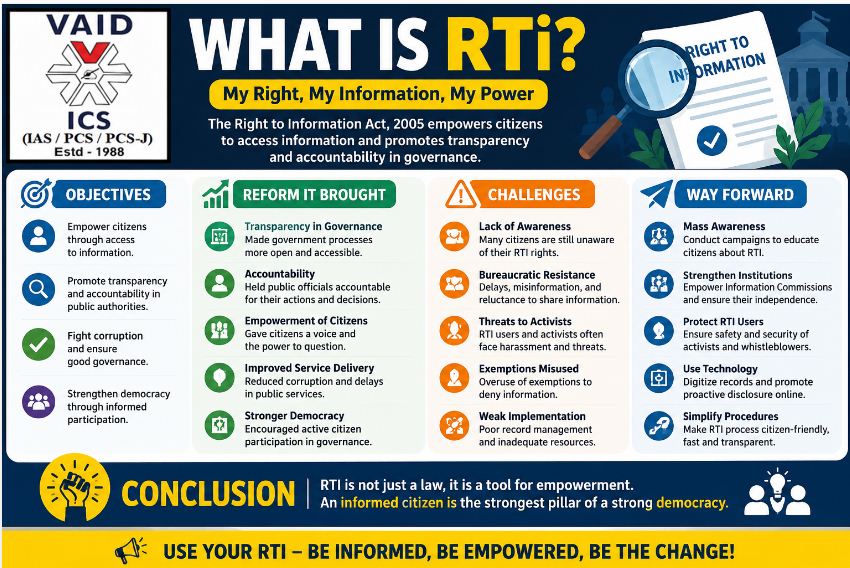
- Empowerment of Citizens: Shifts the paradigm from a “culture of secrecy” (under the colonial Official Secrets Act, 1923) to a “culture of accountability.”
- Promote Transparency: Mandates public authorities to provide administrative and financial data to the public.
- Contain Corruption: Operates as a social audit mechanism over government spending and policy execution.
- Enhance Democratic Participation: An informed citizenry is indispensable for the functional success of a participatory democracy.
Structural and Operational Issues:
Despite being one of India’s most successful transparency legislations, the RTI framework faces critical bottlenecks:
A. Supply-Side Issues (Institutional Failures)
- High Pendency and Backlogs: As of recent reports, over 4 lakh cases remain pending across Central and State Information Commissions. Vacancies of Information Commissioners are kept unfilled for prolonged periods.
- Poor Record Management: Government departments lack digitized, indexed, or systemic archiving methods, leading to delays or the standard reply: “File not traceable.”
- Defiance of Suo-Motu Disclosure (Section 4): Section 4 of the Act mandates proactive public publication of most data so citizens do not need to file applications. This is systematically ignored by most ministries.
- Lack of Protection for Whistleblowers: Scores of RTI activists have been attacked or killed, causing a chilling effect on grass-roots anti-corruption efforts.
B. Legislative Dilutions (Recent Amendments)
- RTI Amendment Act, 2019: Diminished the structural autonomy of the Central & State Information Commissions. It empowered the Central Government to determine the tenure, salaries, and service conditions of Information Commissioners, effectively reducing their status from equivalent to Election Commissioners to that of standard bureaucrats.
- Digital Personal Data Protection (DPDP) Act Amendment (Section 8(1)(j)): Operative via the DPDP Rules, this substituted the original clause to completely exempt all “personal information” from disclosure. It removed the critical “public interest test” and the parliamentary proviso (which stated that information that cannot be denied to Parliament cannot be denied to a citizen), creating a massive blanket loophole for public officials to deny information.
- Deliberative Insulation (Economic Survey Proposals): Recent policy reviews have suggested shielding policy-drafting notes, file notings, and internal ministerial deliberations from public scrutiny before final execution, threatening to reduce transparency in policy-making.
Key Committees and Commission Reports:
A. Second Administrative Reforms Commission (2nd ARC);
- Oath of Secrecy: Recommended amending the Official Secrets Act (OSA), 1923, or replacing it with a chapter in the National Security Act, as the OSA contradicts the spirit of the RTI Act.
- Proactive Disclosures: Advocated for an intense focus on Section 4 compliance, holding the Head of the Department personally liable for missing parameters.
- Single Window System: Suggested establishing a centralized RTI application portal across all state tiers down to the Panchayats.
B. Sarkaria & Punchhi Commissions on Centre-State Relations:
- Emphasized that uniform structural funding must be provided by the Center to State Information Commissions to upgrade their tech infrastructure.
C. Supreme Court Judgments:
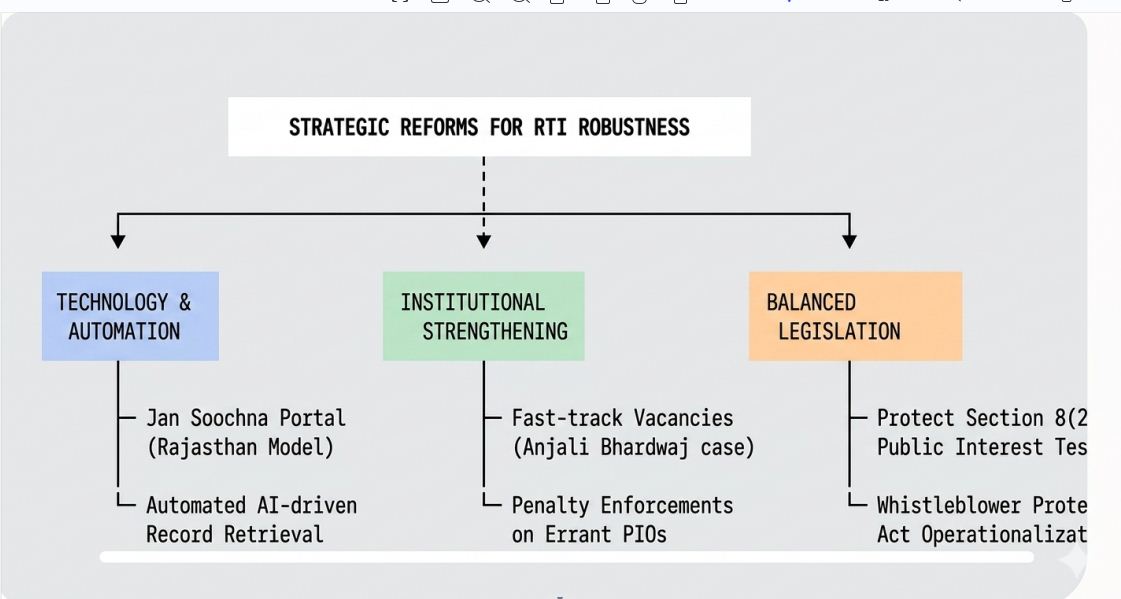
- Anjali Bhardwaj Case (2019): The SC ruled that the government must fill vacancies in Information Commissions in a timely, transparent, and quota-free manner.
- Judicial Accountability (CPIO, SC v. Subhash Chandra Agarwal, 2019): The Supreme Court ruled that the Office of the Chief Justice of India (CJI) is a “public authority” and falls under the RTI Act, provided it balances transparency with judicial independence.
Challenges to the System:
- Frivolous and Vexatious Filings: A small percentage of applicants use the RTI as a tool for blackmail, corporate espionage, settled personal scores, or clogging the department with absurdly vast inquiries.
- The “Privacy vs. Information” Tussle: Striking a delicate balance between a citizen’s right to know and an individual’s fundamental right to privacy (as affirmed in the S. Puttaswamy verdict).
Way Forward:
- The Rajasthan “Jan Soochna” Model: Shift from “Right to Ask” to “Right to Know.” State governments should proactively publish datasets regarding subsidies, works, and rosters on public portals, minimizing the necessity of filing an RTI.
- Restoring Commission Autonomy: To preserve the functional check-and-balance architecture, the tenure and financial independence of Information Commissioners should be insulated from executive whims.
- Harmonizing DPDP and RTI: While executing the DPDP rules, PIOs should rely on Section 8(2) of the RTI Act, which allows the disclosure of even exempted personal information if the larger public interest outweighs the potential harm to an individual.
- Capacity Building: Provide regular legal and technical training to Public Information Officers (PIOs) on how to process, sever (Section 10), and accurately respond to files instead of resorting to blanket rejections.
Conclusion;
The Right to Information Act is the flagship vanguard of democratic accountability in India. It transformed citizens from mere consumers of governance into active monitors of state execution. To ensure that this foundational law does not suffer a structural rollback, the executive must look at the RTI not as an adversarial impediment to governance, but as a crucial diagnostic tool to build a more transparent, corruption-free, and citizen-centric welfare state.
आरटीआई अधिनियम और “लोक प्राधिकारी” (Public Authority) की अवधारणा
चर्चा में क्यों?
केंद्रीय सूचना आयोग (CIC) ने अपने एक हालिया निर्णय में यह व्यवस्था दी है कि भारतीय क्रिकेट कंट्रोल बोर्ड (BCCI) सूचना का अधिकार (RTI) अधिनियम, 2005 की धारा 2(h) के तहत “लोक प्राधिकारी” के दायरे से बाहर है।
सूचना का अधिकार (RTI) अधिनियम, 2005 के तहत “लोक प्राधिकारी” क्या है?
RTI अधिनियम, 2005 की धारा 2(h) के अनुसार, “लोक प्राधिकारी” (Public Authority) से तात्पर्य ऐसी किसी भी अथॉरिटी, निकाय (Body) या स्वशासन की संस्था से है जो स्थापित या गठित की गई हो:
-
A. संविधान के द्वारा या इसके तहत (जैसे: भारत निर्वाचन आयोग, संघ लोक सेवा आयोग – UPSC)।
-
B. संसद द्वारा बनाए गए किसी अन्य कानून द्वारा (जैसे: राष्ट्रीय मानवाधिकार आयोग – NHRC)।
-
C. राज्य विधानमंडल द्वारा बनाए गए किसी अन्य कानून द्वारा (जैसे: राज्य सूचना आयोग)।
-
D. उपयुक्त सरकार (Appropriate Government) द्वारा जारी किसी अधिसूचना या आदेश द्वारा।
इसमें स्पष्ट रूप से निम्नलिखित भी शामिल हैं:
-
कोई भी ऐसा निकाय जो उपयुक्त सरकार द्वारा प्रत्यक्ष या अप्रत्यक्ष रूप से उपलब्ध कराए गए धन से स्वामित्व (Owned), नियंत्रित (Controlled) या पर्याप्त रूप से वित्तपोषित (Substantially Financed) हो।
-
गैर-सरकारी संगठन (NGOs) जो उपयुक्त सरकार द्वारा प्रत्यक्ष या अप्रत्यक्ष रूप से प्रदान किए गए फंड द्वारा पर्याप्त रूप से वित्तपोषित हों।
BCCI एक “लोक प्राधिकारी” क्यों नहीं है? (केंद्रीय सूचना आयोग का निर्णय):
केंद्रीय सूचना आयोग (CIC) ने निर्धारित किया कि BCCI निम्नलिखित आधारों पर आरटीआई अधिनियम की धारा 2(h) के दायरे में नहीं आता है:
-
स्थापना की प्रकृति (Nature of Establishment): BCCI न तो संविधान द्वारा स्थापित किया गया है और न ही संसद या किसी राज्य विधानमंडल द्वारा पारित किसी विशेष वैधानिक कानून (Statute) द्वारा बनाया गया है। यह तमिलनाडु सोसायटी पंजीकरण अधिनियम के तहत पंजीकृत एक निजी, स्वायत्त निकाय (Private, Autonomous Body) है।
-
वित्तीय स्वायत्तता (Financial Autonomy): यह बोर्ड सरकार द्वारा “पर्याप्त रूप से वित्तपोषित” नहीं है। यह एक आत्मनिर्भर कॉर्पोरेट इकाई के रूप में कार्य करता है, जो मीडिया अधिकार (Media Rights), प्रसारण सौदों (Broadcasting Deals), टिकटों की बिक्री और कॉर्पोरेट प्रायोजन (Sponsorships) के माध्यम से स्वतंत्र रूप से अपना भारी राजस्व उत्पन्न करता है।
-
नियंत्रण का अभाव (Lack of Control): सरकार BCCI के दैनिक प्रशासन, पदाधिकारियों के चुनाव या परिचालन संबंधी निर्णयों पर कोई “गहन या व्यापक नियंत्रण” (Deep or Pervasive Control) नहीं रखती है।
ऐतिहासिक संदर्भ / क्षेत्राधिकार में बदलाव: यह निर्णय एक लंबे समय से चले आ रहे विवाद का पटाक्षेप करता है। साल 2018 में, एक पिछले सूचना आयुक्त के आदेश ने विधि आयोग (Law Commission) की सिफारिशों के अनुरूप BCCI को लोक प्राधिकारी घोषित किया था। हालाँकि, यह नवीनतम निर्णय धारा 2(h) के मूल विधिक मापदंडों का कड़ाई से पालन करते हुए उस रुख को पलटता है।
BCCI को RTI अधिनियम के दायरे में लाने के पक्ष में तर्क:
यद्यपि CIC ने एक सख्त विधिक व्याख्या प्रस्तुत की है, लेकिन खेल सुधारों के पैरोकारों और कानूनी विशेषज्ञों का ऐतिहासिक रूप से यह तर्क रहा है कि BCCI को निम्नलिखित कारणों से RTI के प्रति जवाबदेह होना चाहिए:
-
वस्तुतः एकाधिकार और राज्य के कार्य (De Facto Monopoly & State Functions): BCCI भारत में क्रिकेट पर राज्य-स्वीकृत एकाधिकार का आनंद लेता है। यह आधिकारिक राष्ट्रीय टीम का चयन करता है, राष्ट्रीय ध्वज का उपयोग करता है, और अंतर्राष्ट्रीय मंचों (जैसे ICC) पर संप्रभु लोकतांत्रिक गणराज्य भारत का प्रतिनिधित्व करता है।
-
अप्रत्यक्ष सरकारी सब्सिडी (Indirect Government Subsidies): प्रत्यक्ष रूप से वित्तपोषित न होने के बावजूद, BCCI को ऐतिहासिक रूप से बड़े पैमाने पर अप्रत्यक्ष राज्य सहायता प्राप्त हुई है, जिसमें शामिल हैं:
-
राज्य सरकारों द्वारा क्रिकेट स्टेडियमों के लिए अत्यधिक रियायती दरों पर भूमि का आवंटन।
-
धर्मार्थ ट्रस्ट (Charitable Trust) के प्रावधानों के तहत कर छूट (ऐतिहासिक रूप से)।
-
मैचों के दौरान सुरक्षा और रसद (Logistics) पर होने वाला भारी सार्वजनिक व्यय।
-
-
लोकहित और सार्वजनिक कार्य (Public Interest & Public Function): भारत में क्रिकेट महज एक खेल नहीं है; इसमें व्यापक जनहित, जनता की भावनाएँ और हजारों करोड़ रुपये शामिल हैं। सर्वोच्च न्यायालय द्वारा गठित लोढ़ा समिति ने वित्तीय पारदर्शिता सुनिश्चित करने और भ्रष्टाचार पर अंकुश लगाने के लिए BCCI को आरटीआई के दायरे में लाने की सिफारिश की थी।
आरटीआई के दायरे में लाने के खिलाफ तर्क (वर्तमान निर्णय के अनुरूप):
-
स्वायत्तता को खतरा (Threat to Autonomy): आरटीआई अधिनियम को लागू करने से प्रशासनिक अतिरेक (Administrative Overreach), राजनीतिक हस्तक्षेप और तुच्छ मुकदमेबाजी (Frivolous Litigation) बढ़ सकती है, जिससे एक वैश्विक स्तर पर सफल खेल निकाय की कार्यक्षमता प्रभावित होगी।
-
अन्य खेल निकायों के लिए मिसाल (Precedent for Other Sports Bodies): यदि पूरी तरह से स्व-वित्तपोषित निकाय को आरटीआई के तहत बाध्य किया जाता है, तो यह सोसायटी पंजीकरण के तहत काम करने वाले सभी निजी खेल अकादमियों, क्लबों और महासंघों के लिए भी एक जटिल मिसाल (Pandora’s Box) कायम कर देगा।
-
कठोर वैधानिक व्याख्या (Strict Statutory Interpretation): प्रशासनिक कानून में, जब तक कोई इकाई धारा 2(h) की वस्तुनिष्ठ जाँच (स्वामित्व, नियंत्रण या प्रत्यक्ष पर्याप्त वित्तपोषण) को पूरा नहीं करती, तब तक उसे न्यायिक या अर्ध-न्यायिक रूप से लोक प्राधिकारी बनने के लिए मजबूर नहीं किया जा सकता।
आगे की राह (Way Forward):
यह विवाद ‘कानून के सख्त अक्षरों’ (Letter of the Law) और ‘सार्वजनिक जवाबदेही की भावना’ (Spirit of Accountability) के बीच एक क्लासिक संघर्ष को रेखांकित करता है। यद्यपि BCCI तकनीकी रूप से वित्तीय और वैधानिक दृष्टिकोण से एक निजी क्लब की परिभाषा को पूरा करता है, परंतु इसकी कार्यात्मक वास्तविकता सार्वजनिक क्षेत्र से गहराई से जुड़ी हुई है।
निजी खेल निकायों की स्वायत्तता को कम किए बिना इस अंतर को पाटने के लिए, संसद एक विशेष “खेल धोखाधड़ी और पारदर्शिता कानून” (Sports Fraud and Transparency Legislation) लाने पर विचार कर सकती है। यह कानून आरटीआई अधिनियम की संपूर्ण प्रशासनिक मशीनरी को थोपे बिना, सभी राष्ट्रीय खेल महासंघों के लिए वित्तीय प्रकटीकरण (Fiscal Disclosure) और शिकायत निवारण (Grievance Redressal) को अनिवार्य बना सकता है।
सूचना का अधिकार (RTI) अधिनियम, 2005: एक समग्र विश्लेषण
प्रस्तावना और संवैधानिक आधार:
सूचना का अधिकार (RTI) अधिनियम, 2005 को नागरिकों के लिए लोक प्राधिकारियों के नियंत्रण में मौजूद सूचनाओं तक पहुँच सुनिश्चित करने के लिए लागू किया गया था।
-
संवैधानिक दायरा: यद्यपि संविधान में इसका स्पष्ट उल्लेख नहीं है, लेकिन सर्वोच्च न्यायालय ने (उत्तर प्रदेश राज्य बनाम राज नारायण, 1975) यह व्यवस्था दी थी कि आरटीआई एक अंतर्निहित मौलिक अधिकार है जो अनुच्छेद 19(1)(a) (वाक और अभिव्यक्ति की स्वतंत्रता) और अनुच्छेद 21 (प्राण और दैहिक स्वतंत्रता का अधिकार) से उत्पन्न होता है।
आरटीआई अधिनियम के मुख्य उद्देश्य:
-
नागरिकों का सशक्तिकरण: यह शासन व्यवस्था को औपनिवेशिक ‘आधिकारिक गोपनीयता अधिनियम, 1923’ की “गोपनीयता की संस्कृति” से “जवाबदेही की संस्कृति” की ओर स्थानांतरित करता है।
-
पारदर्शिता को बढ़ावा देना: यह लोक प्राधिकारियों को जनता को प्रशासनिक और वित्तीय डेटा प्रदान करने के लिए बाध्य करता है।
-
भ्रष्टाचार पर अंकुश: यह सरकारी खर्च और नीति कार्यान्वयन पर एक ‘सामाजिक अंकेक्षण’ (Social Audit) तंत्र के रूप में कार्य करता है।
-
लोकतांत्रिक भागीदारी को बढ़ाना: एक सहभागी लोकतंत्र की कार्यात्मक सफलता के लिए एक सूचित नागरिक समाज (Informed Citizenry) अपरिहार्य है।
संरचनात्मक और परिचालन संबंधी मुद्दे (Structural and Operational Issues):
भारत के सबसे सफल पारदर्शिता कानूनों में से एक होने के बावजूद, आरटीआई ढांचे को कई गंभीर बाधाओं का सामना करना पड़ रहा है:
A. आपूर्ति-पक्ष के मुद्दे (संस्थागत विफलताएँ)
-
मामलों का अत्यधिक लंबित होना (High Pendency): हालिया रिपोर्टों के अनुसार, केंद्रीय और राज्य सूचना आयोगों में 4 लाख से अधिक मामले लंबित हैं। सूचना आयुक्तों के पद लंबे समय तक रिक्त रखे जाते हैं।
-
खराब रिकॉर्ड प्रबंधन (Poor Record Management): सरकारी विभागों में डिजिटल, अनुक्रमित (Indexed) या व्यवस्थित संग्रह विधियों का अभाव है, जिससे देरी होती है या यह मानक उत्तर मिलता है: “फाइल मिल नहीं रही है।”
-
स्वतः प्रकटीकरण (धारा 4) की अवहेलना: अधिनियम की धारा 4 अनिवार्य करती है कि अधिकांश डेटा सार्वजनिक पोर्टलों पर स्वतः (Proactively) प्रकाशित किया जाए ताकि नागरिकों को आवेदन करने की आवश्यकता ही न पड़े। अधिकांश मंत्रालयों द्वारा इसे व्यवस्थित रूप से नजरअंदाज किया जाता है।
-
व्हिसलब्लोअर्स के लिए संरक्षण की कमी: कई आरटीआई कार्यकर्ताओं पर हमले हुए हैं या उनकी हत्या कर दी गई है, जिससे जमीनी स्तर पर भ्रष्टाचार विरोधी प्रयासों पर प्रतिकूल प्रभाव (Chilling Effect) पड़ा है।
B. विधायी कमजोरियाँ (हालिया संशोधन):
-
आरटीआई संशोधन अधिनियम, 2019: इसने केंद्रीय और राज्य सूचना आयोगों की संरचनात्मक स्वायत्तता को कम कर दिया। इसने केंद्र सरकार को सूचना आयुक्तों के कार्यकाल, वेतन और सेवा शर्तों को निर्धारित करने की शक्ति दे दी, जिससे उनका दर्जा निर्वाचन आयुक्तों के समकक्ष से घटकर सामान्य नौकरशाहों जैसा हो गया।
-
डिजिटल व्यक्तिगत डेटा संरक्षण (DPDP) अधिनियम संशोधन (धारा 8(1)(j)): इसके तहत, सभी “व्यक्तिगत जानकारी” को प्रकटीकरण (Disclosure) से पूरी तरह मुक्त कर दिया गया है। इसने महत्वपूर्ण “जनहित परीक्षण” (Public Interest Test) और संसदीय प्रावधान को हटा दिया (जिसमें कहा गया था कि जो जानकारी संसद को देने से मना नहीं की जा सकती, वह नागरिक को भी मना नहीं की जा सकती), जिससे लोक अधिकारियों को जानकारी छिपाने का एक बड़ा बहाना मिल गया है।
-
विमर्श संबंधी संरक्षण (Deliberative Insulation): हालिया नीतिगत समीक्षाओं में नीति-प्रारूपण नोट्स (Policy-drafting notes), फाइल नोटिंग्स और आंतरिक मंत्रालयी विमर्श को अंतिम रूप से लागू होने से पहले सार्वजनिक जांच से बचाने का सुझाव दिया गया है, जो नीति-निर्माण में पारदर्शिता के लिए खतरा है।
प्रमुख समितियाँ और आयोगों की रिपोर्ट:
A. द्वितीय प्रशासनिक सुधार आयोग (2nd ARC)
-
गोपनीयता की शपथ: आयोग ने आधिकारिक गोपनीयता अधिनियम (OSA), 1923 में संशोधन करने या इसे राष्ट्रीय सुरक्षा अधिनियम (NSA) के एक अध्याय से बदलने की सिफारिश की, क्योंकि OSA की प्रकृति आरटीआई अधिनियम की भावना के विपरीत है।
-
अग्रसक्रिय प्रकटीकरण (Proactive Disclosures): धारा 4 के अनुपालन पर गहन ध्यान देने की वकालत की, और मापदंडों के उल्लंघन के लिए विभागाध्यक्ष को व्यक्तिगत रूप से उत्तरदायी ठहराने की बात कही।
-
एकल खिड़की प्रणाली (Single Window System): पंचायतों तक सभी राज्य स्तरों पर एक केंद्रीकृत आरटीआई आवेदन पोर्टल स्थापित करने का सुझाव दिया।
B. केंद्र-राज्य संबंधों पर सरकारिया और पुंछी आयोग
-
इस बात पर बल दिया कि राज्य सूचना आयोगों के तकनीकी बुनियादी ढांचे को उन्नत करने के लिए केंद्र द्वारा समान संरचनात्मक वित्तपोषण प्रदान किया जाना चाहिए।
C. सर्वोच्च न्यायालय के महत्वपूर्ण निर्णय:
-
अंजलि भारद्वाज मामला (2019): सुप्रीम कोर्ट ने फैसला सुनाया कि सरकार को सूचना आयोगों में रिक्तियों को समयबद्ध, पारदर्शी और कोटा-मुक्त तरीके से भरना चाहिए।
-
न्यायिक जवाबदेही (CPIO, SC बनाम सुभाष चंद्र अग्रवाल, 2019): सर्वोच्च न्यायालय ने व्यवस्था दी कि भारत के मुख्य न्यायाधीश (CJI) का कार्यालय एक “लोक प्राधिकारी” है और यह आरटीआई अधिनियम के अंतर्गत आता है, बशर्ते यह न्यायिक स्वतंत्रता के साथ पारदर्शिता का संतुलन बनाए रखे।
प्रणाली के समक्ष चुनौतियाँ:
-
तुच्छ और परेशान करने वाले आवेदन (Frivolous & Vexatious Filings): आवेदकों का एक छोटा प्रतिशत आरटीआई का उपयोग ब्लैकमेलिंग, कॉर्पोरेट जासूसी, व्यक्तिगत स्कोर सेट करने या जानबूझकर विभाग को भारी-भरकम पूछताछ से ठप करने के लिए करता है।
-
“गोपनीयता बनाम सूचना” का संघर्ष: नागरिक के जानने के अधिकार और किसी व्यक्ति के गोपनीयता के मौलिक अधिकार (के.एस. पुट्टस्वामी निर्णय) के बीच एक नाजुक संतुलन बनाना।
आगे की राह (Way Forward):
-
राजस्थान का “जन सूचना” मॉडल: “मांगने के अधिकार” से “जानने के अधिकार” की ओर बढ़ना। राज्य सरकारों को सार्वजनिक पोर्टलों पर सब्सिडी, कार्यों और रोस्टर के संबंध में डेटासेट सक्रिय रूप से प्रकाशित करने चाहिए, जिससे आरटीआई दाखिल करने की आवश्यकता न्यूनतम हो जाए।
-
आयोग की स्वायत्तता की बहाली: संस्थागत संतुलन (Checks and Balances) को बनाए रखने के लिए, सूचना आयुक्तों के कार्यकाल और वित्तीय स्वतंत्रता को कार्यकारी सनक से सुरक्षित किया जाना चाहिए।
-
DPDP और RTI में सामंजस्य: DPDP नियमों को लागू करते समय, लोक सूचना अधिकारियों (PIOs) को आरटीआई अधिनियम की धारा 8(2) का सहारा लेना चाहिए, जो व्यापक लोकहित होने पर छूट प्राप्त व्यक्तिगत जानकारी को भी प्रकट करने की अनुमति देता है।
-
क्षमता निर्माण (Capacity Building): लोक सूचना अधिकारियों (PIOs) को नियमित कानूनी और तकनीकी प्रशिक्षण प्रदान किया जाना चाहिए कि कैसे वे फाइलों को संसाधित करें, पृथक (Section 10 – Severability) करें और सटीक उत्तर दें, न कि सीधे तौर पर आवेदनों को खारिज करें।
निष्कर्ष:
सूचना का अधिकार अधिनियम भारत में लोकतांत्रिक जवाबदेही का प्रमुख अग्रदूत (Flagship Vanguard) है। इसने नागरिकों को शासन के मूक उपभोक्ताओं से राज्य के सक्रिय निरीक्षकों में बदल दिया है। यह सुनिश्चित करने के लिए कि इस बुनियादी कानून का संरचनात्मक पतन न हो, कार्यपालिका को आरटीआई को शासन में एक बाधा के रूप में नहीं, बल्कि एक अधिक पारदर्शी, भ्रष्टाचार मुक्त और नागरिक-केंद्रित कल्याणकारी राज्य के निर्माण के लिए एक अनिवार्य उपकरण के रूप में देखना चाहिए।

May 19, 2026
October 17, 2025
October 16, 2025
October 6, 2025

